

One use case
Commerce
“Hiking boots for Iceland in October under $250”
SuggestAPI reads
- → Destination
- → Season
- → Budget
- → Category
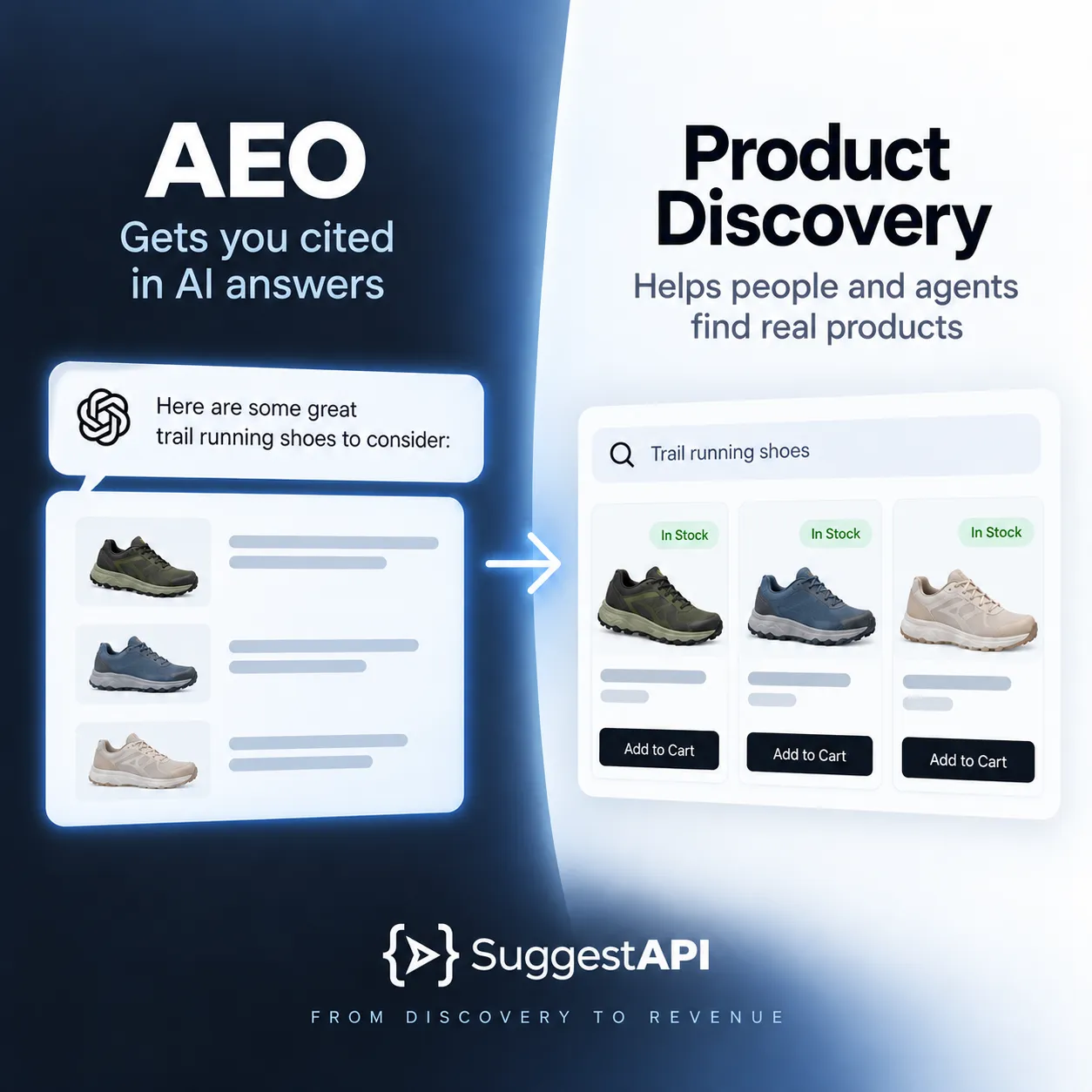
A citation puts you in the answer. It does not close the sale. SuggestAPI is the discovery layer that comes next: current items a person or an agent can actually buy, from the search you already run.
Read the argumentWorks with the search you already run
Algolia · Typesense · Elasticsearch · Meilisearch · Shopify · SeekStorm · Vespa · Searchspring · Athos Commerce · Upstash Search
The crawler delay
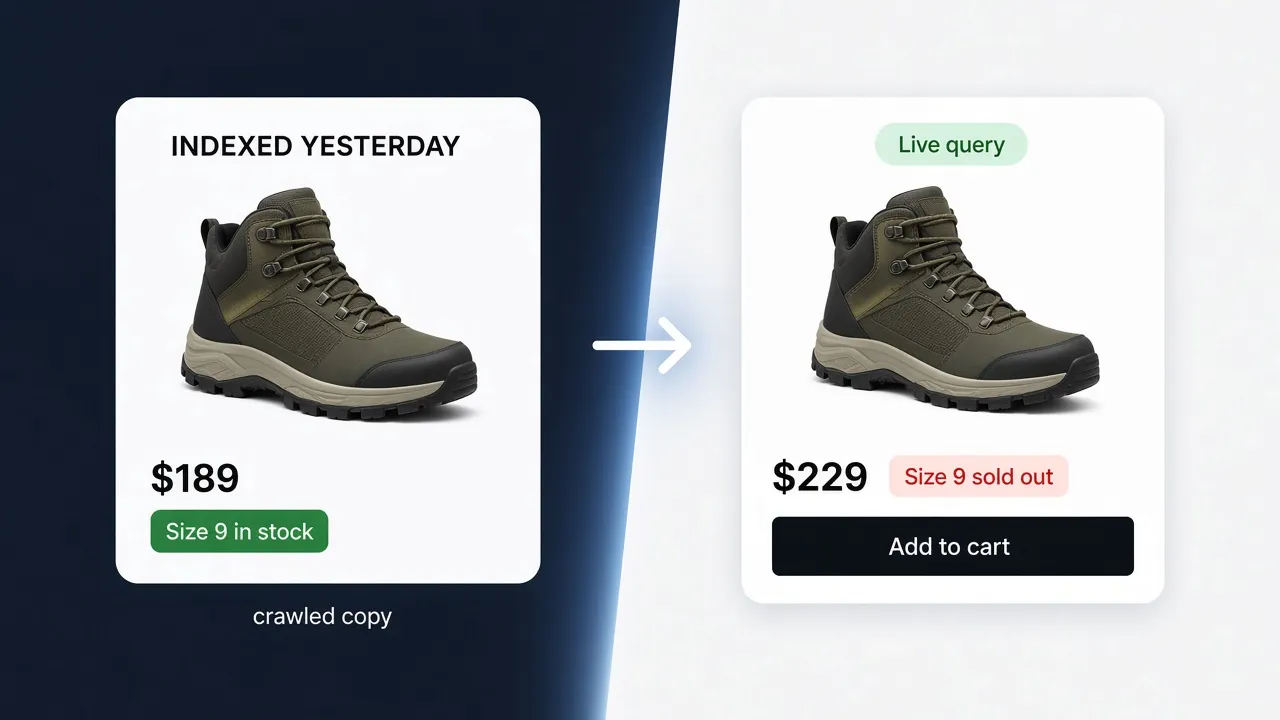
A size 9 can sell out at noon and still look in stock in a search result. A citation names the merchant. A live query checks the price and the stock right now.
Read why the index lagsWhat changes
Commerce, documentation, and industrial catalogs share one pattern. SuggestAPI turns a messy request into the constraints your existing search can use.
One use case
“Hiking boots for Iceland in October under $250”
SuggestAPI reads
Docs and SaaS
“How do I rotate a workspace API key?”
SuggestAPI reads
Industrial catalogs
“316SS 1/2 in valve, 3000 PSI”
SuggestAPI reads
What SuggestAPI adds
01
Extract constraints from natural language, whether the record is a product, a document, or a part.
02
Rewrite, route, filter, and rank requests for the engine already underneath.
03
Preserve the request when someone refines, compares, or asks a follow-up.
04
Hand back structured matches, not only a keyword string.
Why we built this
People search with messy, persistent requests. Existing search drops that context after one query. You shouldn’t have to rebuild discovery for every new app or assistant.
People, apps, and agents reach SuggestAPI first. SuggestAPI understands the request and keeps that context. Your existing search finds and ranks records. Your application takes the next step.
Who starts
People · Apps · AI agents
SuggestAPI
Understands the request · keeps context
Your existing search
Finds and ranks from the index you already run
Your application
Takes the next step
One layer for the request
Intent and constraint extraction, search acceleration, and agent discovery sit in front of the engine you already chose, so a new assistant doesn’t mean a new search stack, and a follow-up doesn’t mean starting over.
01 / Understand
Extract use case, budget, timing, preferences, and constraints from natural language, then send structured filters and ranking context to the search engine you already run. No replatform.
Intent Retrieve
Explore retrieval →02 / Accelerate
Return relevant results fast: query rewriting, routing, caching, and delivery straight through your existing search stack.
Ask Find
How it works →03 / Agents
The same index, structured so AI assistants can search and act. Commerce is one path: compare, recommend, and hand off to checkout. The merchant keeps the cart.
Compare Handoff
See protocols →Your search and index stay where they are.
Same intent, ready for agents
Agents need the request kept intact so they can search, compare, and act without changing the index underneath. The same request arrives already interpreted, whether it is a product, a document, or a part number.
id · title · fields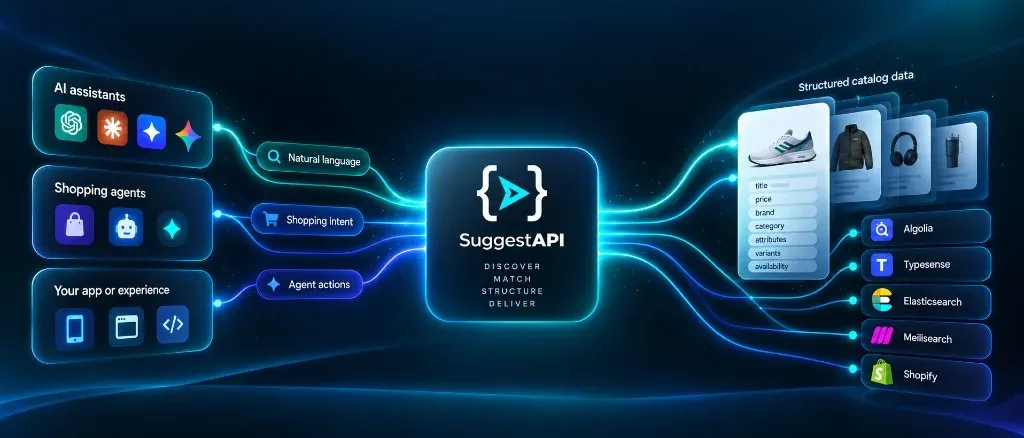
Agent path
Intent → structure
For your stack
Keep the engine you already run, including Algolia, Typesense, Elasticsearch, Meilisearch, Shopify, SeekStorm, Vespa, Searchspring, Athos Commerce, and Upstash Search. SuggestAPI sits in front. If you don’t have an engine yet, index your own data.

 Watch the walkthrough

Adapter notes in Bring Your Own Search.
For your stackBuilt for the agentic web.
A request that starts in ChatGPT, Gemini, a copilot, or another agent still needs structured results from the index you already have. SuggestAPI is the discovery layer that makes that handoff possible.
Agents connect over MCP and WebMCP at the SuggestAPI Agent Gateway (agent.suggestapi.com). Search tools cover the index you already run. The commerce path adds four tools: search, recommend, compare, and product lookup. A WebMCP manifest covers browser-oriented agents.
See supported protocols →Discovery
Agent-ready
What leaves your team
A discovery layer is real work. SuggestAPI takes it off the team, so what remains is search analytics, agent discovery, and ranking you can measure against the business.
In-house3–6 months for a production gateway
With SuggestAPIA proxy in front of the search you already run
In-houseAgent bursts land on the search cluster
With SuggestAPIEdge cache. On Scale, about $0.60 per 1,000 included requests
In-houseA wrapper per engine and a project per protocol
With SuggestAPIOne API. Agent Discovery is included on every paid plan
In-houseAn engineer on the gateway, about $150K+/year in opportunity cost
With SuggestAPISchema changes for MCP, UCP, ACP, ARD, and OKF stay on SuggestAPI
Metered usage
When every agent call and every search request lands on a plan that meters usage, the same question is billed again. A SuggestAPI cache hit answers it from the edge.
Another unit
Each agent call and each search request counts on the plan you already pay, including when they ask the same thing again.
$0.60
Per 1,000 on Scale. The provider’s meter does not move. The request is a Discovery Request instead.
Where the effort goes
Usage and query events on every plan. See what people and agents asked, and which journeys come back empty.
Search features →The same catalog, published for assistants. MCP, UCP, ACP, ARD, and OKF are included. There is no separate fee per protocol.
Protocols →Pins, boosts, and schema ranking you control, with the query evidence in front of you. With Convertmax, revenue comes back so ranking can follow conversion and revenue per search, not only clicks.
With Convertmax →The 3–6 months is an in-house production gateway. The $0.60 per 1,000 is Scale’s included Discovery Requests (plan price divided by one million). Overage above that allowance is priced separately. The $150K+/year is the opportunity cost of an engineer on gateway maintenance, not a measured saving for every customer. See the cost comparison. Plan limits. Ranking from revenue.
Capture demand your search is losing.
Connect the search you already run, or index your own data. Understand the request from the first ask through the next step, for people and agents.