

01
Search abstraction
One interface across the providers, query syntax, and response formats already in your stack.
Bring your own search →The discovery layer
One API for intelligent search and AI-ready discovery. Ingest from APIs, files, feeds, and sites, or connect the search you already run. SuggestAPI accelerates search, understands the request, and returns results applications and AI agents can use.
Keep the engine you have.
Why now
Customers still search on your site. But a product journey can now begin in a mobile app, inside an AI assistant, or through a shopping agent acting on someone’s behalf. Those are all discovery surfaces, and they all need a reliable way into the same catalog.
The usual answer is a pile of one-off integrations. That gets expensive to maintain fast.
SuggestAPI gives those surfaces a shared route into the infrastructure you already trust.
How SuggestAPI works
SuggestAPI sits between your product data and the experiences that need to use it. It does not ask you to replace Algolia, Typesense, Elasticsearch, Meilisearch, Shopify, or the rest of your stack. It gives each consuming experience the same discovery interface instead.
Your website can use /search. Your app can use /autocomplete. An agent can use structured discovery tools. Underneath, the source system can stay exactly where it is.
A stable interface
Search providers all have their own query rules, authentication patterns, ranking controls, and response shapes. If every application talks directly to every provider, the coupling starts to spread.
SuggestAPI normalizes the requests and responses at the edge. That means a frontend team can work with a stable interface while your search or commerce team keeps control of the provider underneath.
Agentic product discovery
Search boxes were built for people. Agents need a different kind of access: a way to understand what a merchant offers, what actions are available, and how to retrieve structured results.
SuggestAPI can expose those capabilities as machine-readable discovery tools. Depending on your implementation, that can include MCP, A2A, WebMCP, UCP, ACP, catalog search tools, capability descriptions, and agent-discovery metadata.
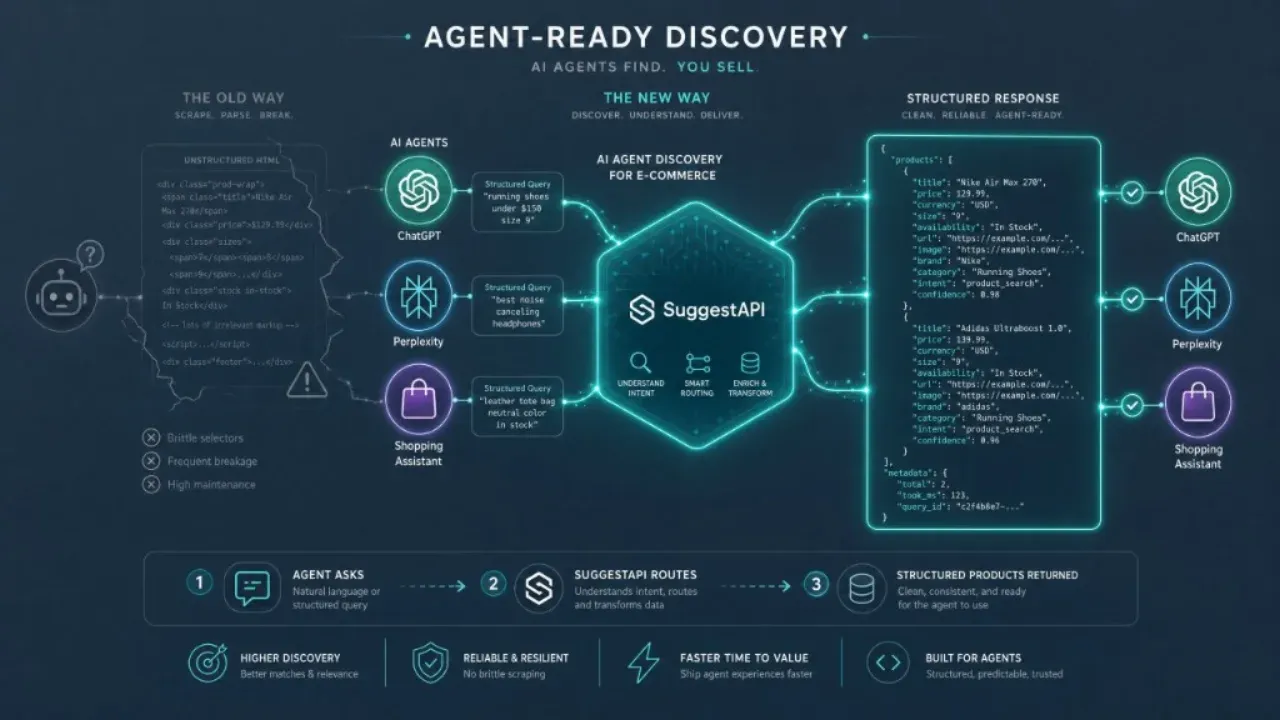
Structured access
Agents need a contract, not a search box. The catalog stays the source of truth.
Why it matters
Without a discovery layer, each new experience tends to grow its own direct link to your underlying system. With SuggestAPI, those experiences share one layer instead. Less duplicated work. Fewer brittle dependencies. A cleaner point of change when your stack evolves.
01
One interface across the providers, query syntax, and response formats already in your stack.
Bring your own search →02
Structured tools and capability descriptions for systems that need more than a search box.
Google ARD →03
A better place to handle caching, rewriting, normalization, and discovery analytics.
Retrieval abstraction →Keep your engine
SuggestAPI is not another search engine to migrate to. If Algolia works for you, keep it. If the catalog lives in Shopify, keep it there. SuggestAPI separates the experience using discovery from the engine that runs the query.
That separation matters when you want to change providers, add a new app, or make your catalog available to an interface that does not exist yet.
Make discovery portable without moving the foundation.
The short version
Bring your current catalog and search stack to the web, apps, and the next generation of agents without rebuilding the foundation.
Sign up to map the catalog systems you already have, the surfaces you need to serve, and the discovery layer that can connect them.