

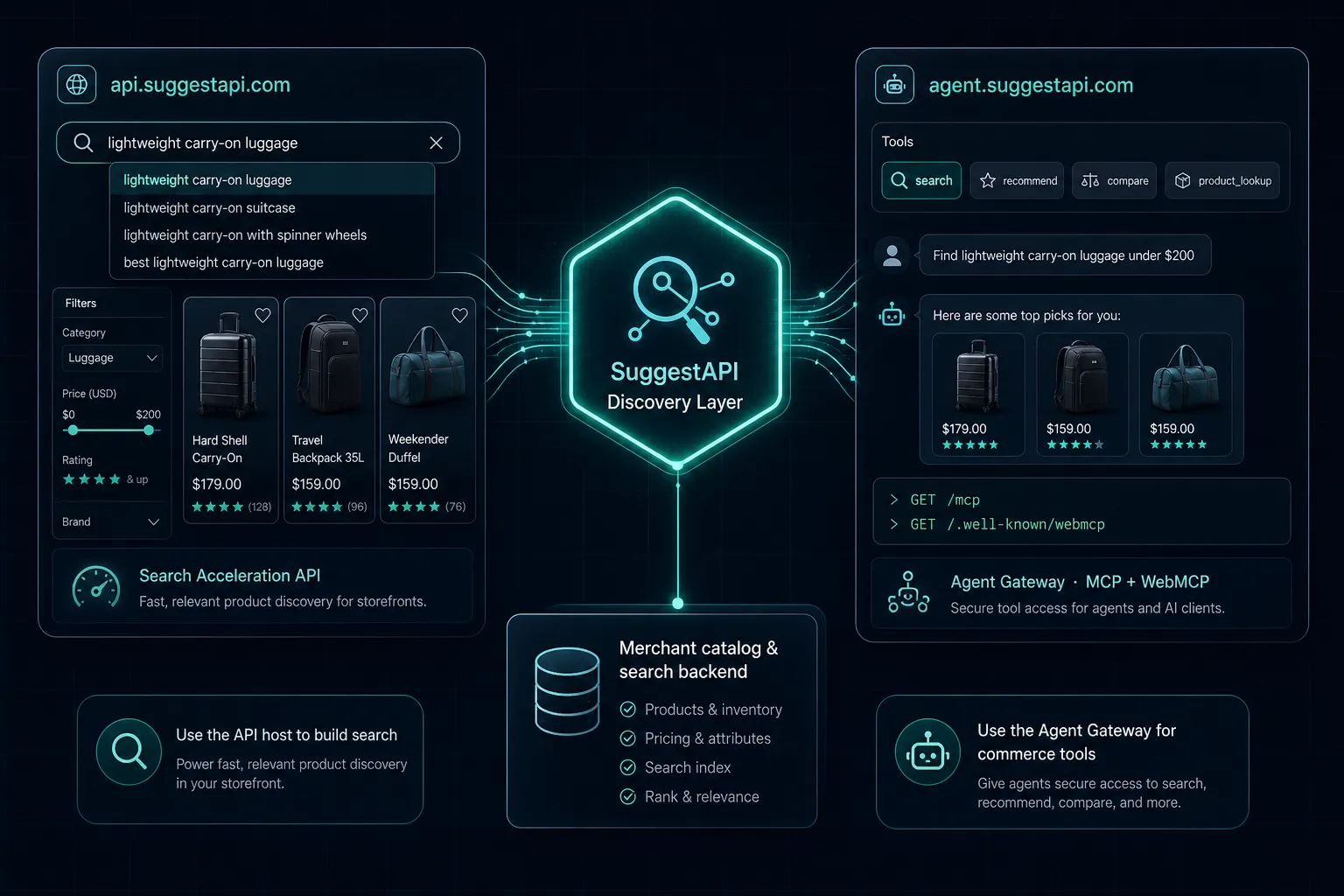
Summary. SuggestAPI exposes tenant-aware commerce tools through MCP and WebMCP on the Agent Gateway, while api.suggestapi.com remains the direct Search Acceleration API.
A catalog should not need one integration for shoppers, another for applications, and a third for AI agents. The data is the same. The discovery job is the same. Only the caller changes.
That is the idea behind SuggestAPI’s two public surfaces. api.suggestapi.com is the direct Search Acceleration API for storefronts, applications, ingestion, and ranking. agent.suggestapi.com is the Agent Gateway, where MCP and WebMCP expose tenant-aware commerce tools to agents and agent-capable clients. Both sit in front of the catalog and search infrastructure you already run. Neither requires a replatform.
Use the API host to build search experiences. Use the Agent Gateway when an agent needs discoverable commerce tools.
Two hosts, one discovery job
The domains have different jobs by design. They share the discovery layer below them, but they are not interchangeable. That boundary keeps an implementation legible: your application talks to the search API, while an agent talks to an agent-ready interface.
| Surface | Best for | Start here | What it exposes |
|---|---|---|---|
https://api.suggestapi.com | Storefronts, applications, ingestion, and search operations | /openapi.json | Autocomplete, typeahead, index management, catalog ingestion, merchandising, and graph recommendations |
https://agent.suggestapi.com | Agents, plugins, registries, and agent-aware commerce flows | /.well-known/okg.json | Tenant search, product lookup, comparison, recommendations, commerce handoff metadata, MCP, WebMCP, and discovery documents |
The direct API is where you wire a search box, send catalog records, tune an index, or call a search capability from an app. Its machine-readable OpenAPI contract documents GET and HTTP QUERY variants for autocomplete and typeahead, as well as index and catalog operations.
The Agent Gateway takes catalog capability and turns it into tools. It publishes tenant-aware search and product workflows over REST, streamable HTTP MCP, and a WebMCP tool manifest. An assistant can discover and call a stable commerce interface instead of trying to decipher product data from a rendered page.
MCP belongs on the Agent Gateway
Model Context Protocol, or MCP, is the runtime interface for clients that want a tool connection. SuggestAPI publishes its streamable HTTP MCP endpoint here:
https://agent.suggestapi.com/mcpThe public descriptor identifies the service as SuggestAPI Commerce Search, advertises streamable HTTP, and declares protocol version 2025-06-18. Its discovery files are public too, which lets clients and registries find the connection without relying on an undocumented URL.
| Published MCP resource | Purpose |
|---|---|
/.well-known/mcp.json | States that MCP is supported and points to the server manifest |
/.well-known/mcp/server.json | Registry-compatible server metadata and a streamable HTTP remote |
/.well-known/mcp-manifest.json | A concise manifest for clients that need tool names and the connection URL |
/mcp | The streamable HTTP JSON-RPC runtime for MCP clients |
Once connected, an MCP client can list and call four commerce tools. Each is a thin protocol wrapper over a Knowledge Gateway operation. The caller supplies a merchant domain as the tenant, keeping the request scoped to the catalog it is meant to query.
| MCP tool | What it does | REST operation behind the tool |
|---|---|---|
search | Searches a tenant’s products, collections, content, and policies | POST /v1/agent/search |
recommend | Returns recommendations for a natural-language request | POST /v1/agent/recommend |
compare | Compares selected catalog objects across structured attributes | POST /v1/agent/compare |
product_lookup | Retrieves a canonical product record by ID | GET /v1/agent/product/{id} |
That matters for a simple reason: tool calling should not become a second catalog or a side channel. The MCP layer sits on the same tenant-aware retrieval and orchestration surface as the Agent Gateway REST API. A merchant keeps control of the catalog, the storefront, and the native commerce flow.
WebMCP describes the browser-facing tool surface
MCP solves a server-to-client tool connection. WebMCP tackles another part of the problem: helping browser-based agents understand which structured actions are available, rather than guessing from controls and page markup.
SuggestAPI publishes a machine-readable WebMCP manifest here:
https://agent.suggestapi.com/.well-known/webmcpThe manifest describes the same four commerce actions, their JSON input schemas, and the REST endpoint associated with each action. search, for example, requires a tenant and a natural-language query. compare requires a tenant and an array of object IDs. The document also points MCP-capable clients to the Agent Gateway’s MCP endpoint.
| WebMCP tool | Required input | Intended outcome |
|---|---|---|
search | tenant, query | Search a catalog and knowledge surface with a selectable retrieval mode |
recommend | tenant, query | Generate a tenant-scoped recommendation set |
compare | tenant, ids | Return structured differences among catalog objects |
product_lookup | tenant, id | Retrieve one canonical tenant product record |
It is worth being exact about the word WebMCP. Chrome describes it as a proposed web standard for exposing structured tools to agents through browser APIs and HTML annotations. It is still changing and is being tested through an origin trial, so browser and agent support will vary. SuggestAPI’s published manifest gives clients an explicit, inspectable description of the commerce tools today. It does not suggest that every browser already implements the experimental browser API.
The difference is practical. MCP is the server connection for an agent client. WebMCP is the browser-oriented tool vocabulary and discovery model. SuggestAPI supports both paths without asking a merchant to pick between its existing frontend and an agent-facing catalog interface.
The request path stays simple
This is not a migration. It is a routing choice based on the caller.
Storefront or application
        │
        └── api.suggestapi.com
                │
                └── Search acceleration, retrieval, and catalog operations

Agent or MCP client
        │
        └── agent.suggestapi.com
                │
                └── MCP or WebMCP discovery
                        │
                        └── Tenant-aware commerce tools
                                │
                                └── Existing catalog and search backend
A search bar can keep using https://api.suggestapi.com/v1/autocomplete or /v1/typeahead. A custom agent can connect to https://agent.suggestapi.com/mcp. A browser-oriented agent can read the WebMCP manifest. And a team that prefers plain HTTP can call the Agent Gateway REST endpoints directly. Every path leads back to structured merchant catalog data, not a scraped stand-in for it.
Which surface should you use?
There is no reason to make every caller speak MCP. Use the protocol that matches the job.
| If you are building… | Use this surface | Why |
|---|---|---|
| A storefront search field or autocomplete UI | api.suggestapi.com | It is the direct Search Acceleration API for fast search interaction and catalog operations. |
| A shopping or coding assistant that needs callable commerce tools | agent.suggestapi.com/mcp | The Agent Gateway publishes the MCP runtime and four tenant-aware tools. |
| A browser-oriented agent experience | agent.suggestapi.com/.well-known/webmcp | The manifest describes structured inputs and tool destinations for commerce actions. |
| An integration that prefers ordinary HTTP | agent.suggestapi.com/v1/agent/* or /oks/{tenant}/* | The Gateway exposes REST retrieval and higher-level agent workflows alongside MCP. |
| A coding agent implementing direct search integration | api.suggestapi.com with suggestapi/skills | The direct API remains the implementation surface for search and catalog work. |
The last row is intentional. api.suggestapi.com is not the MCP host. It is the direct API for search and catalog capability. The MCP and WebMCP entry points live at agent.suggestapi.com, where they package agent-oriented discovery, tenancy, and commerce workflows around that core capability.
Merchant control still comes first
Agent discovery should expand where a catalog can be found. It should not move the merchant’s source of truth somewhere else.
SuggestAPI keeps the existing search engine and catalog under the discovery layer. Agent workflows can retrieve products, content, and policies; compare products; generate recommendations; and return handoff metadata for native cart or checkout flows. They do not replace the merchant’s cart, checkout, or payment platform.
That is why the two-surface design holds up. The direct API keeps search implementation practical for systems already in production. The Agent Gateway gives AI clients a well-described way to find and call commerce capability. The catalog stays in the merchant’s hands.
Start with the interface your caller already understands
For a storefront or application, begin with the Search API OpenAPI contract. For an MCP client, point it to https://agent.suggestapi.com/mcp and inspect the server manifest. For browser-oriented tool discovery, read the WebMCP manifest.
The agentic web will not come from asking merchants to throw away their search stack. It will come from giving the catalog a clear, structured route to the people, applications, and agents trying to find something in it.
Frequently asked questions about MCP and WebMCP
What is the difference between api.suggestapi.com and agent.suggestapi.com?
api.suggestapi.com is the direct Search Acceleration API for storefronts, applications, ingestion, and ranking. agent.suggestapi.com is the Agent Gateway, where MCP, WebMCP, and tenant-aware commerce tools are published.
Where is SuggestAPI’s MCP endpoint?
The streamable HTTP MCP runtime is https://agent.suggestapi.com/mcp. Discovery documents live under /.well-known/mcp.json, /.well-known/mcp/server.json, and /.well-known/mcp-manifest.json on the same host.
Which MCP tools does SuggestAPI expose?
Four tenant-aware commerce tools: search, recommend, compare, and product_lookup. Each is a protocol wrapper over the matching Agent Gateway REST operation.
How is WebMCP different from MCP?
MCP is the server-to-client tool connection. WebMCP is a browser-oriented tool vocabulary and discovery model. SuggestAPI publishes a WebMCP manifest at /.well-known/webmcp describing the same four commerce actions.
Should a coding agent implementing search use MCP?
Not by default. Direct search and catalog work still belongs on api.suggestapi.com, with SuggestAPI Skills as the implementation playbook. Use MCP when an agent needs discoverable commerce tools.