

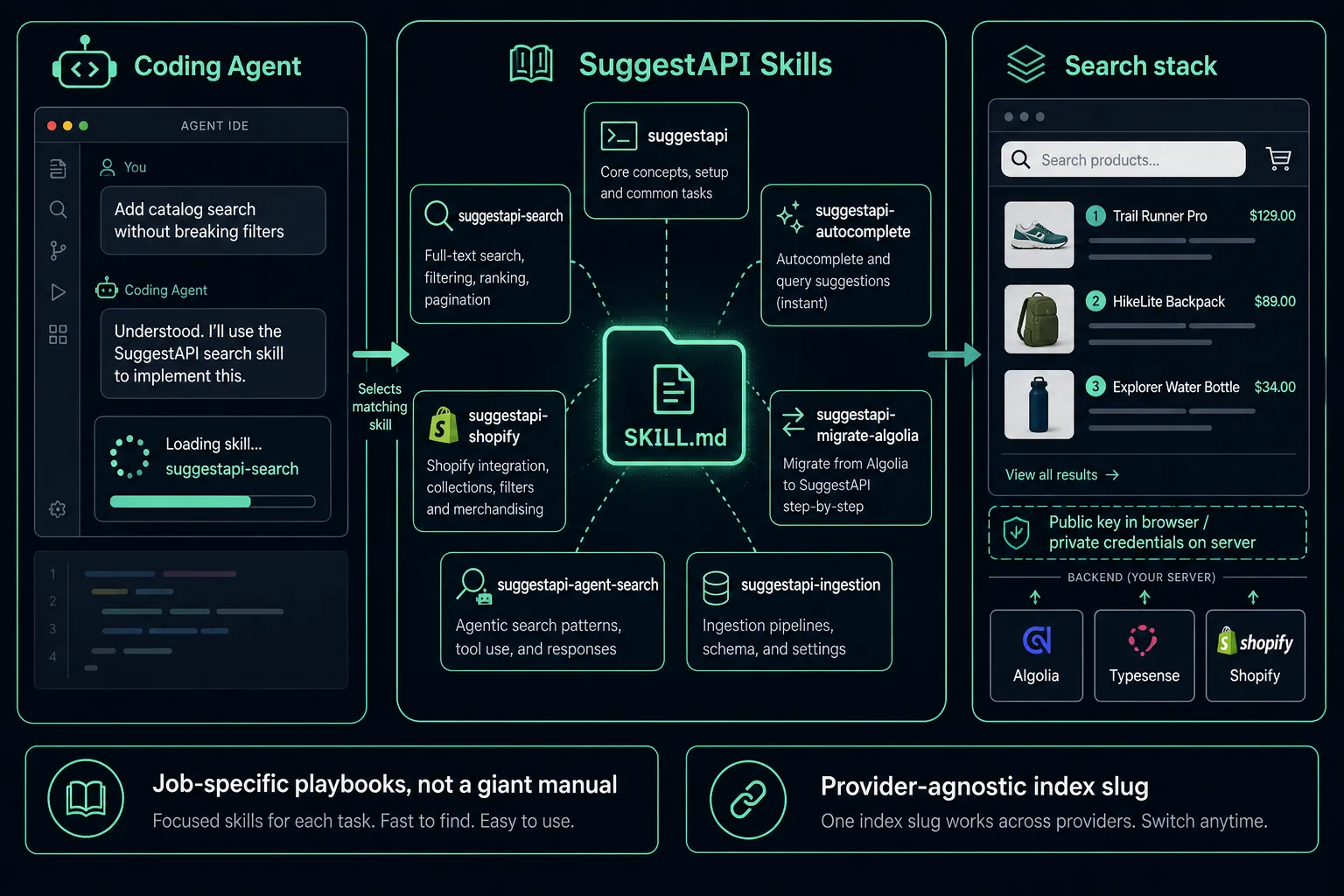
Summary. SuggestAPI Skills give coding agents focused guidance for search, autocomplete, commerce, migrations, agent retrieval, and catalog ingestion.
A coding agent can write a search component in minutes. That is rarely the hard part.
The difficult bit is the handoff between a broad request and the product details that make an integration hold up in production: the result contract your UI already relies on, the index to query, the credential boundary, the migration constraints, and the tests that show the work is actually done.
SuggestAPI Skills puts that knowledge in front of the agent at the right time. Rather than asking a general-purpose assistant to guess how a particular SuggestAPI job should work, teams can give it a focused skill for catalog search, typeahead, a Shopify storefront, an Algolia migration, agent-facing retrieval, or index management. The open-source project is available in the suggestapi/skills repository.
Agent Skills are lightweight folders built around a SKILL.md file. They give agents instructions and can include references, scripts, and other working materials. A compatible agent discovers a skill, loads it when the task fits, then follows the workflow it contains.Search work is more than an endpoint call
A general coding assistant may know how to send an HTTP request. It does not automatically know which promises your search experience already makes to users, which IDs must remain stable, or which credentials should never land in browser code.
That is especially important when you are changing an established search experience. You may need to retain filters and pagination. You may need to preserve result URLs and analytics semantics. Or you may be moving to a new routing layer while keeping your existing search provider in place. Autocomplete today and full ranked results next week are related projects, but they are not interchangeable.
SuggestAPI Skills makes those differences plain. Every skill is built around a job, not just a family of API endpoints. The agent gets a compact operating brief that fits the task, instead of a huge product manual and the vague instruction to “add search.” That leads to a more repeatable path from implementation request to working code, verification, and the right safety checks.
What is in the repository?
The repository includes one orientation skill and seven specialist skills. The orientation skill is intentionally narrow. It is for a request that is still fuzzy. When a developer has already said “autocomplete,” “Shopify,” “Algolia migration,” or “ingestion,” the agent should use the matching specialist directly rather than taking a detour through the general guide.
| Skill | When an agent should use it |
|---|---|
suggestapi | The implementation goal is still unclear and the agent needs to select the right path. |
suggestapi-search | Build full application or ecommerce catalog search, filters, and result pages. |
suggestapi-autocomplete | Build search-bar autocomplete or typeahead. |
suggestapi-shopify | Connect SuggestAPI to a Shopify theme or Hydrogen storefront. |
suggestapi-migrate-algolia | Move an existing Algolia implementation behind SuggestAPI. |
suggestapi-typesense | Route a Typesense-backed implementation through SuggestAPI. |
suggestapi-agent-search | Give an AI assistant or copilot access to live catalog and search results. |
suggestapi-ingestion | Handle indexing, document management, imports, synchronization, and catalog loading. |
The division is deliberate. A Shopify storefront has different needs from an agent importing documents. An agent-facing catalog tool needs different guardrails from a typeahead field. Keeping those jobs separate lets the specialist skills stay short and easy to find. Each contains its own API reference, so it can stand on its own.
What an agent actually gets
Consider the full-search skill. It does not end with “call the API.” It tells the agent to inspect the existing search call site, including query parameters, filters, pagination, and result rendering. Then it identifies the SuggestAPI index slug, replaces the provider-specific request without breaking the UI contract, maps returned suggestions into the application model, and handles empty or degraded responses without making up products.
For ranked search, the documented route is GET /v1/autocomplete. The skill also draws a clean line between public browser search and trusted server-side writes: a public SuggestAPI key can serve storefront search, while private credentials remain on the server. It specifically tells the agent not to pass upstream-provider configuration to the client.
That is the value of a skill. Product knowledge, architecture preferences, and verification steps become usable instructions when the code is being written, not a list of things someone remembers to check later.
Keep the application provider-agnostic
SuggestAPI Skills is a good fit for teams that do not want their front end permanently tied to one search engine. The orientation skill describes SuggestAPI as an acceleration and abstraction layer in front of an existing search backend. The application works with a stable index slug; SuggestAPI can route that index to an upstream provider and return a normalized response.
There is a practical migration benefit here. The client can keep familiar result URLs, identifiers, filters, and analytics semantics where possible, without baking backend-specific behavior into the browser. The repository’s rule is simple: upstream provider credentials do not belong in browser or agent code.
Designed for implementation, not just advice
The repository treats correctness as part of the job. Its specialist skills tell agents to check the current API documentation and public OpenAPI specification before release, rather than treating a static prompt as the final authority. The project includes scripts to validate skills, check the OpenAPI description, and run live smoke tests for search and typeahead. It also includes routing evaluation prompts that help verify whether a request reaches the intended skill.
So this is not a folder of loose notes. It is a version-controlled playbook for the decisions that are easy to skip when a coding agent starts with a one-line task.
Get started with SuggestAPI Skills
Install with npx skills add suggestapi/skills. The Skills CLI places the folders where Claude Code, Codex, Google Antigravity, Cursor, GitHub Copilot, Gemini CLI, and other Agent Skills clients look. You can also add one self-contained skill folder when a single job is all you need. The repository README lists the skills and validation commands. The individual SKILL.md files lay out routing rules and implementation expectations.
Begin with the task that is in front of you. Adding product search? Use suggestapi-search. Improving a search box? Use suggestapi-autocomplete. Not sure which path fits? Start with suggestapi and let the orientation skill make the call.
Explore SuggestAPI Skills on GitHub before your agent starts changing the search stack.
Frequently asked questions about SuggestAPI Skills
What are SuggestAPI Skills?
SuggestAPI Skills are focused Agent Skills that give a coding agent the playbook for a specific search job: catalog search, autocomplete, Shopify, Algolia migration, Typesense routing, agent retrieval, or catalog ingestion.
When should an agent use the orientation skill?
Use the suggestapi orientation skill only when the implementation goal is still unclear. If the request already names autocomplete, Shopify, Algolia migration, or ingestion, the agent should load the matching specialist skill directly.
Which skill should I use for autocomplete versus full catalog search?
Use suggestapi-autocomplete for search-bar typeahead. Use suggestapi-search for full application or ecommerce catalog search, filters, and result pages.
Do SuggestAPI Skills put search provider credentials in the browser?
No. A public SuggestAPI key can serve storefront search. Private credentials and upstream-provider configuration stay on the server, not in browser or agent code.
How do I install SuggestAPI Skills?
Run npx skills add suggestapi/skills (see suggestapi/skills). That works for Claude Code, Codex, Antigravity, Cursor, Copilot, Gemini CLI, and other Agent Skills clients. Add one self-contained skill folder when a single job is all you need. Domain probe: /.well-known/agent-skills/index.json.