

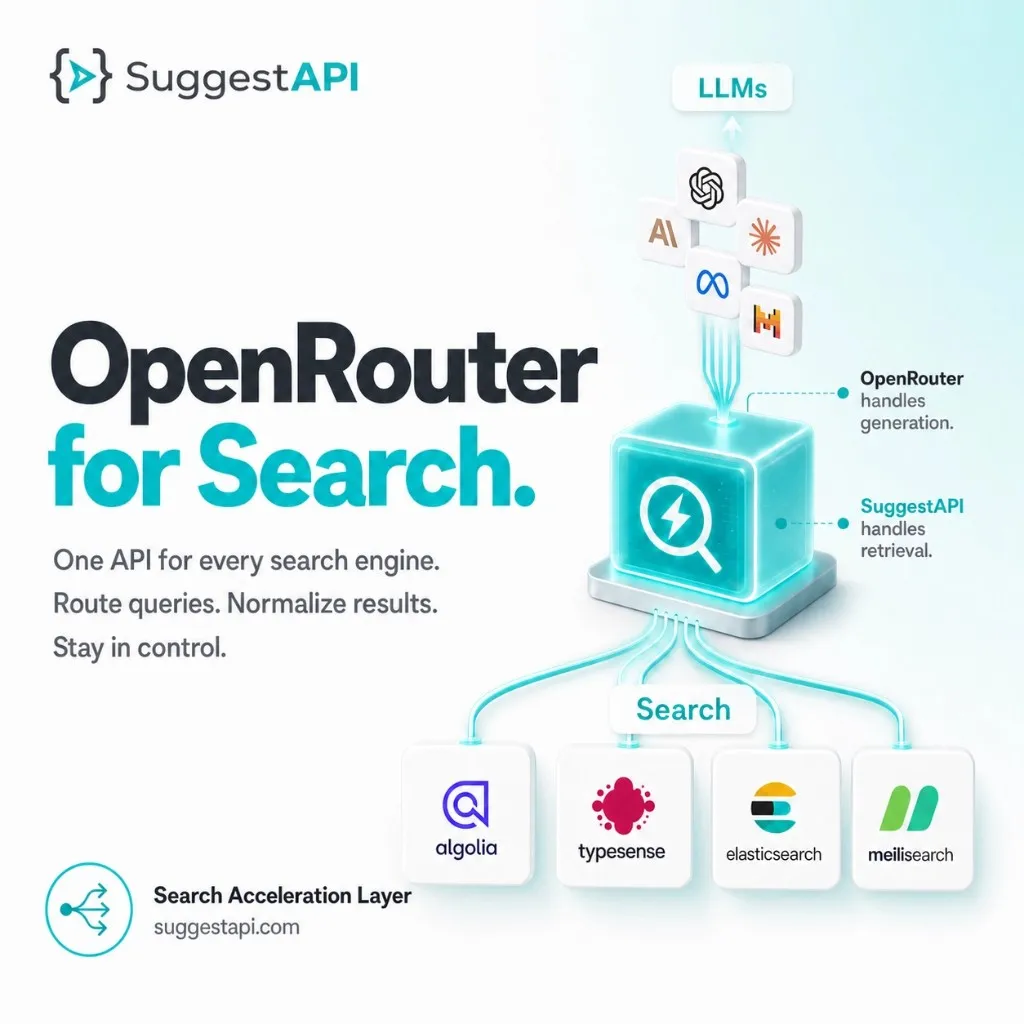
Summary. Why retrieval needs an abstraction layer: use one API to route, normalize, and accelerate search across Algolia, Typesense, Elastic, and Meilisearch.
When developers build applications with large language models today, they rarely hardcode their infrastructure to a single provider. Instead, they use abstraction layers like OpenRouter to route generation requests to the best available model, whether that is from OpenAI, Anthropic, or an open-source alternative. This abstraction provides flexibility, fallback capabilities, and a unified API interface.
The other half of the AI equation is retrieval, and that landscape remains heavily fragmented. Developers are still hardcoding their applications directly to specific search engines like Algolia, Typesense, Elasticsearch, or Meilisearch. This is why we built SuggestAPI: to serve as the universal abstraction layer for search and knowledge retrieval.
The Retrieval Fragmentation Problem
Retrieval is fundamentally broken across silos. An e-commerce platform might use Algolia for product search, a custom vector database for semantic matching, and an internal knowledge base for customer support. When building AI agents or unified search experiences, connecting to these disparate systems requires writing custom integration code, managing different response formats, and handling varying latency profiles for each backend.
SuggestAPI solves this by sitting between your applications and your search backends. It is to search and knowledge what OpenRouter is to LLMs.
Instead of asking "Which AI should answer this?", SuggestAPI answers the question "Where should this knowledge come from?" By routing queries through a single, unified API, developers can decouple their frontend applications and AI agents from the underlying search infrastructure. See the Bring Your Own Search guide for how adapter configuration and endpoint families work in practice.
Core Capabilities of the Abstraction Layer
Operating as an abstraction layer allows SuggestAPI to provide several critical capabilities that are difficult to achieve when connected directly to a single search engine:
| Capability | The Old Way (Direct Connection) | The SuggestAPI Way |
|---|---|---|
| API Integration | Multiple proprietary APIs to manage | One unified API for all search backends |
| Provider Routing | Hardcoded to a single search engine | Dynamic routing to the best search provider |
| Response Format | Inconsistent JSON schemas across vendors | Normalized, predictable search result format |
| Edge Acceleration | Dependent on the origin server's latency | Cloudflare edge caching for instant results |
| Vendor Lock-in | High switching costs and migration risk | Swap backends instantly with zero migration |
By normalizing the search API, SuggestAPI gives engineering teams the freedom to compare search engines side-by-side. You can route queries to Algolia today, test Typesense tomorrow, and switch to Elasticsearch next week, all without changing a single line of code in your storefront or application frontend.
The Missing Link for AI Agents
The need for a retrieval abstraction layer becomes even more urgent in the context of AI agents. While human users interact with visual search bars, AI shopping assistants and autonomous agents require structured, machine-readable data to compare products, understand intent, and make recommendations.
Currently, agents often resort to brittle HTML scraping or rely on generic category page matches because they cannot effectively query the underlying product catalogs. SuggestAPI makes catalogs agent-ready by returning structured, normalized product JSON.
When an agent needs to find "waterproof hiking boots size 11", SuggestAPI routes the query to the appropriate backend, normalizes the response, and delivers clean product objects containing exact prices, stock status, and variations. This transforms discovery into a seamless process for AI, ensuring that agents can shop and retrieve knowledge as effectively as humans do. For more on why agents need both retrieval and intent ranking, read our article on modern agents and intent understanding.
Beyond Basic Routing
While the OpenRouter analogy perfectly captures the core abstraction mechanism, the vision for SuggestAPI extends further into performance optimization. Because SuggestAPI sits at the edge, it can perform query rewriting, typo recovery, and caching before the request ever reaches the origin search engine.
This edge acceleration reduces average latency down to 30ms, providing an instant autocomplete experience even if the underlying origin index is slow. It effectively acts as a CDN for search APIs, combining the routing intelligence of OpenRouter with the edge performance of Cloudflare.
The future of the internet is agentic, and agents require unified access to knowledge, commerce, and search. SuggestAPI is building the universal retrieval infrastructure to make that future possible.