

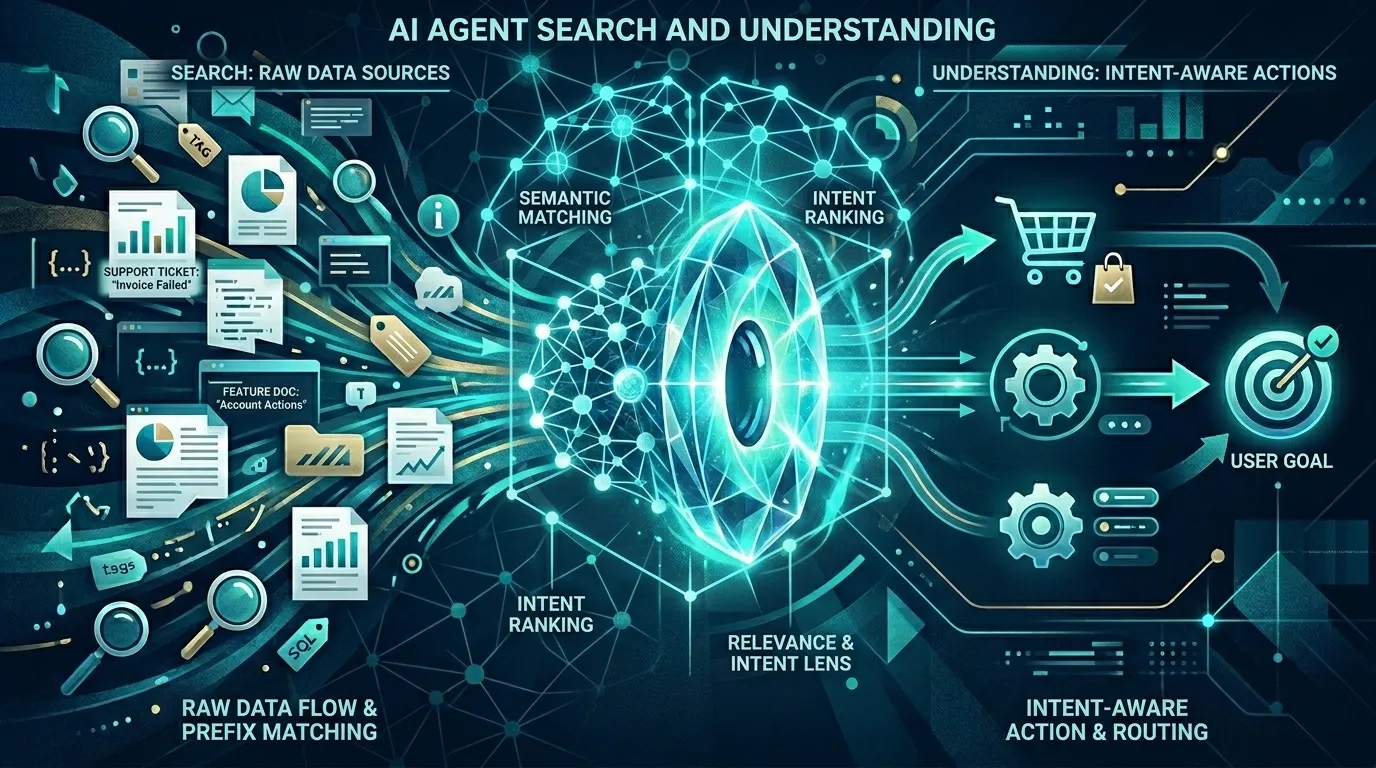
Summary. AI agents need retrieval and intent ranking on a search acceleration layer, not just tool access, to find catalog items and next actions.
The demos all look effortless: a chipper assistant compares two jackets, checks inventory, swaps a variant. Behind the curtain, though, most production pain is boring: wrong SKU ranked first, a category page that matches the words but not the job, a shopping flow that retrieves "laptop bag" when the shopper meant "13 inch sleeve." Agents magnify those mistakes because they act faster than a human scanning ten blue links.
Search is how an agent pulls in fresh, site-specific ground truth: SKUs, inventory, reviews, variant data, and merchandising rules. Intent understanding is how it decides whether "waterproof" means boots, jackets, or camping gear. Retrieval without intent is a confident wrong answer; intent without retrieval is confident hallucination. You need both wired together before the UI stops feeling like a slot machine.
Modern agents do not just need access to data. They need a reliable way to retrieve the right context and rank the right action from messy human language.
That is why we treat the storefront search bar, and copilot fields on commerce sites, as part of the agent stack, not a legacy widget. What we ship in SuggestAPI assumes suggestions are structured enough for software to act on, not just strings for a human to read. Otherwise your model is doing improv on top of a brittle keyword list.
Agents Are Only as Good as Their Ground Truth
An agent differs from a basic chatbot because it can plan, use tools, and take action. In practice, that means a production agent needs to do more than generate plausible text. It needs to identify a goal, gather relevant evidence, choose a path, and adapt based on what it learns.
This is where search becomes foundational. A shopping agent needs current catalog data, inventory, reviews, and filters. A marketplace agent needs to search across sellers, brands, and duplicate listings. A merchandising-aware agent needs boosted SKUs, collections, and category rules. In each case, the agent's reasoning improves when it can retrieve the right environment-specific context rather than relying on stale model memory.
| Agent Scenario | What Search Retrieves | Why Intent Understanding Matters |
|---|---|---|
| Ecommerce shopping assistant | Products, categories, availability, reviews, and merchandising rules | The same phrase may imply comparison, purchase readiness, gift discovery, or fitment questions. |
| Marketplace agent | Listings across sellers, brands, pricing, and availability | A shopper typing "waterprof boots" likely wants products, not a blog post that merely contains those words. |
| Large catalog retailer | SKUs, specs, compatibility, variants, and fitment data | The agent must distinguish between browse, compare, reorder, and technical specification queries. |
| Agent commerce copilot | Structured product feeds, collections, and checkout-ready data | The agent must infer whether the shopper wants a product, a category, a bundle, or a comparable alternative. |
The table shows why search alone is not enough. Retrieval supplies options, but agents still need to map a user's language to the right objective. This is the same principle behind the framework on our understanding page, where the system moves from raw query to likely meaning and then to the best outcome.
The Limits of Autocomplete in Agentic Interfaces
Autocomplete was tuned for a narrow job: shave keystrokes when someone already knows the SKU or brand they want. Agent surfaces inherit the same component, but the success metric changes from "did they pick a suggestion?" to "did we move the purchase journey forward without a detour?" Saving a few characters on a well-labeled product name is fine; confidently offering the wrong category because it prefix-matched is not.
So the mismatch is structural. Literal completion rewards overlap with your internal vocabulary; agents need overlap with the user's goal, even when their words do not line up with yours. That is the gap we explain on the how it works page: same UI control, different contract with the user about what a suggestion is allowed to imply.
Search Finds Candidates; Intent Chooses the Path
For an agent, every interaction begins with ambiguity. The user may be asking a question, requesting an action, exploring options, or trying to recover from a problem. The same words can imply different intents depending on context.
A robust agentic search layer must therefore combine several relevance signals. Fast lexical matching is still important because exact terms, prefixes, and typo tolerance are efficient and precise. Semantic matching is important because shoppers describe products in different words than merchandising teams use internally. Behavioral relevance is important because clicks, conversions, and successful completions reveal which suggestions actually help. Business controls are important because teams may need to promote strategic products, pin hero SKUs, or filter results by customer segment.
| Capability | Why It Matters for Agents | What It Enables in Product UX |
|---|---|---|
| Lexical and prefix matching | Captures exact names, abbreviations, and fast partial-input matches. | Instant suggestions that feel native to the storefront search bar. |
| Typo tolerance | Handles messy input before the user finishes typing. | Fewer dead ends and less frustration for users on mobile or under time pressure. |
| Semantic understanding | Recognizes related meaning even when labels do not match. | Users can describe problems or desired outcomes instead of memorizing product terminology. |
| Intent ranking | Prioritizes the most likely next step, not merely the closest text match. | Suggestions become product guidance, not just query completion. |
| Structured results | Returns objects an application or agent can act on. | Agents can deep-link to product pages, trigger compare flows, or route shoppers to the right category. |
| Business controls | Lets teams shape high-value journeys intentionally. | Merchandising, category promotion, curated collections, and segment-specific experiences. |
The strongest agent experiences combine all of these. A vector-only system may understand meaning but miss precise product labels or struggle with latency-sensitive interfaces. A keyword-only system may be fast but brittle when users speak naturally. A generic model may infer intent but lack fresh, structured, business-controlled data. Modern agents need a layer that brings these capabilities together, especially in the kinds of high-value use cases where product discovery and conversion directly affect business outcomes.
Intent Understanding Turns Search Into Action
The practical difference between search and intent-aware suggestion becomes clear when the output changes. A standard search endpoint often returns documents, products, or text suggestions. That can work for a results page. But agents need outputs that are closer to decisions.
If a shopper types "waterprof boots," a generic search result might return a blog post, a generic footwear category, a size guide, and unrelated accessories. An intent-aware suggestion layer can instead return waterproof hiking boots, work boots, and rain boot categories, with structured product data the agent can compare and act on. This is not just a relevance improvement. It changes the role of the search bar from a passive lookup box into an active product discovery layer.
The Business Case: Fewer Dead Ends, Better Journeys, More Control
From a user's perspective, intent-aware agent search feels like the product understands them. From a business perspective, it reduces the costly gap between what customers type and what the product can provide.
| Business Problem | Traditional Search Failure | Intent-Aware Agent Search Outcome |
|---|---|---|
| High cart abandonment from search | Shoppers type vague product needs and receive literal or empty results. | The system maps need-based language to relevant categories, products, or bundles. |
| Low attach rate and cross-sell | Shoppers cannot find compatible accessories, sizes, or related items. | The agent suggests the right complementary products from messy natural language. |
| Poor category discovery | Shoppers do not know the internal name of a product line or collection. | The search layer connects shopper goals to categories, brands, and curated collections. |
| Manual synonym maintenance | Teams create brittle rules for every phrase variation. | Meaning similarity and behavioral signals reduce dependence on one-off tuning. |
| Generic agent responses | The model answers without current product context. | Search grounds the agent in real, ranked, structured product data. |
This is why better search quality is not only a UX improvement. It also supports measurable business outcomes, the same ones we call out on the benefits page around conversion, guidance, and reduced friction.
What Modern Agent Builders Should Look For
Teams building shopping agents should evaluate search infrastructure differently than they evaluated site search a few years ago. The question is not only, "Can shoppers find a product?" It is, "Can the agent understand a fuzzy request, retrieve the right options, rank the right next step, and return something the application can act on?"
A strong agent-ready search layer should be fast enough for live interfaces, tolerant of partial and misspelled input, capable of semantic matching, aware of behavioral relevance, configurable by business teams, and able to return structured results. It should support the way shoppers actually ask for things, not just the way catalog systems name things.
Conclusion: The Agent Interface Starts at the Search Bar
The future of agents will not be defined only by larger models or more tools. It will be defined by how well those agents understand goals, retrieve context, and choose the right action. Search gives agents access to the world inside a product. Intent understanding tells them what part of that world matters right now.
Modern agents need search. But the agents users will trust need something more: search that understands intent.