

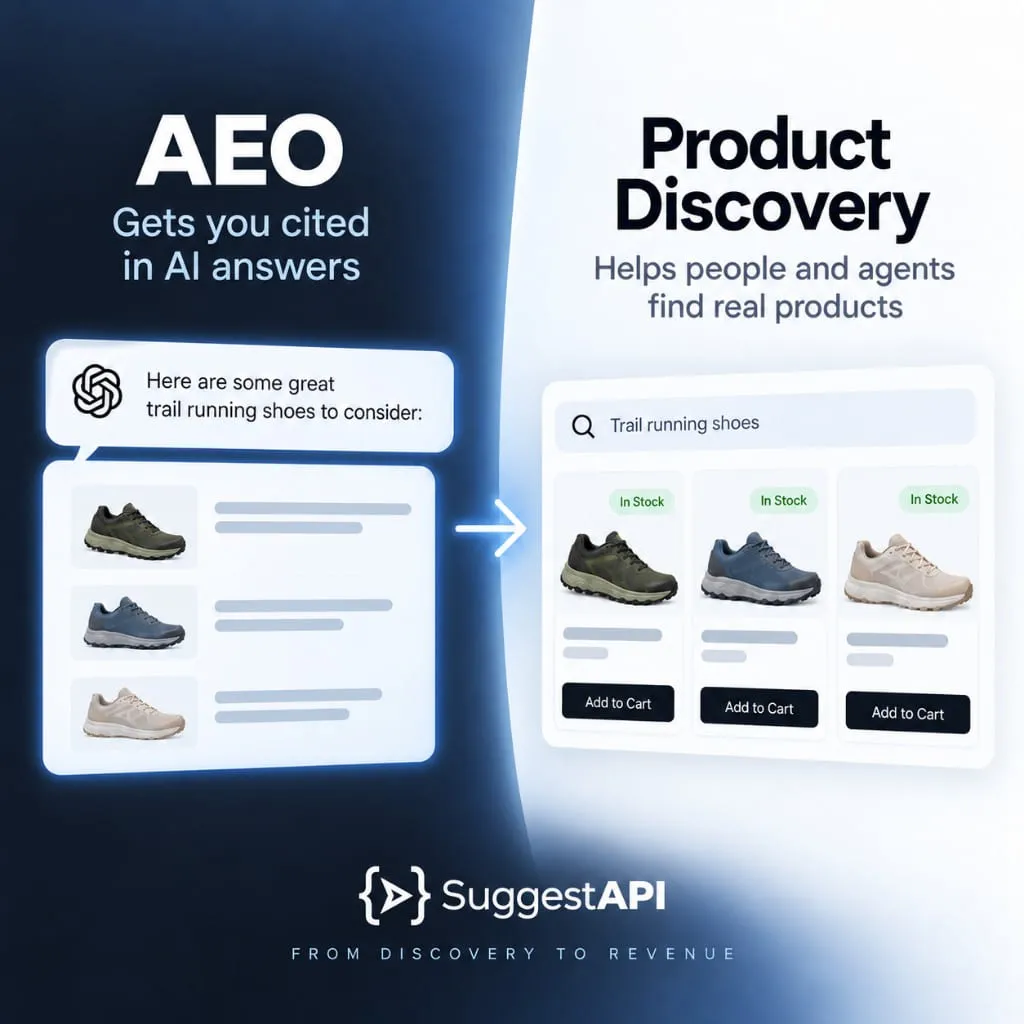
Summary. AEO can earn a citation in an AI answer. Product discovery helps shoppers and agents find current, relevant items in your catalog and move toward checkout.
Getting cited in an AI answer is good for a merchant. It can put a buying guide, a category, or a brand in front of someone who has never visited the site.
But a citation is not a product result. And it is not a route to checkout.
That difference is getting lost in the rush toward answer engine optimization, or AEO. The work matters. A site should be clear, crawlable, credible, and easy for an AI search system to understand. Google says its AI Overviews and AI Mode surface relevant links, and may run several related searches while preparing an answer. Its advice is not a mysterious new playbook: publish helpful content, use internal links, keep structured data aligned with visible page text, and maintain current Merchant Center information. [1]
Still, people do not always show up with a question that one linked page can settle. They show up with a job.
Find waterproof boots for Iceland in October. Keep it under $250. Make sure a size 9 is in stock. Compare the pairs that are actually available.
A broad AI answer can start that trip. It cannot finish it.
AEO gets a merchant into the answer. Product discovery gets the right item into the shopper’s hands.
Both belong in a commerce strategy. They simply solve different parts of the same journey.
A citation can create interest, but discovery still has to do the selling work
AEO makes a business and its information more likely to be useful as an answer engine assembles a response. A strong guide can show expertise, explain a category, and send a qualified visitor to a storefront. In Google Search, a page needs to be indexed and eligible for a normal search snippet before it can appear as a supporting link in AI Overviews or AI Mode. Google does not require a separate AEO-only markup format. [1]
Storefront discovery has a more immediate assignment. It has to turn a shopper’s words, a half-finished query, or a follow-up question into products that fit. Then it has to give that shopper the facts needed to decide: price, availability, variants, sizing, shipping constraints, and a useful next click.
| Question | AEO citation | Purchase-ready product discovery |
|---|---|---|
| Main job | Act as a helpful, supportable source in an AI answer | Retrieve items that fit the shopper’s current buying task |
| What appears | A linked guide, category, brand, or product page | Ranked products, filters, comparisons, and a path to product detail or cart |
| What success looks like | Relevant appearances and qualified referral visits | Product views, useful refinements, add-to-cart rate, checkout starts, and revenue |
| How fresh the data needs to be | Important, though a page may still explain a durable topic | Non-negotiable. Price, inventory, variants, and policies need to match the current catalog |
| How it handles follow-ups | May answer one research question well | Needs to keep the shopper’s constraints through refinements and comparisons |
This is not a semantic argument. It affects what teams build and what they celebrate. If a merchant can point to an AI citation but cannot say which products a visitor found, whether those items were in stock, or whether search led to a cart, it has measured awareness. It has not measured discovery.
Why the purchase journey needs more than a cited page
A citation usually leads to a page. A buying decision needs an active retrieval and comparison experience.
Consider the query: “What are good trail shoes for wet weather?” An AEO-friendly article might win a link by explaining lug patterns, waterproof membranes, and drying tradeoffs. That is useful research. But the shopper still has several practical questions: Which pairs are available in my size? Which ones are wide enough? Which ones fit my budget? Which can arrive before Friday?
Those are catalog facts, not just copywriting. And they move around. A size sells out. A promotion ends. A product gets discontinued. A genuinely good buying guide can remain true while its product links become bad choices.
That is why live product discovery cannot depend on marketing pages or old model knowledge alone. The retrieval layer needs a connection to the catalog or search system that already represents the store’s inventory. SuggestAPI is built around that idea. It can sit in front of an existing search backend or index while the merchant keeps its catalog and checkout underneath. For agent requests, SuggestAPI routes search, comparison, and recommendation calls through that backend so product information stays current without revealing private credentials. [2]
A buyable product result needs four things a citation does not
Mentioning an item is not enough. A commerce result needs to make a choice possible.
| What the result needs | Information behind it | Why it matters |
|---|---|---|
| Intent | Use case, budget, preferences, exclusions, location, timing | The shopper means more than the last keyword typed |
| Retrieval | Product titles, taxonomy, attributes, synonyms, semantic relevance, merchandising rules | The result set must fit the job, even when the wording is vague or imperfect |
| Live commerce facts | SKU, current price, inventory, variant availability, shipping and policy details | The store should not recommend an item the shopper cannot buy |
| Handoff | Product URL, selected variant, cart or checkout action | Discovery should lead to a next step, not another dead-end search |
The same is true inside the storefront search bar. Basic autocomplete predicts text. A discovery-focused suggestion layer should offer useful next actions while the query is still incomplete, including products, categories, and collections. SuggestAPI describes that as ranking the next step rather than merely finishing a phrase, with support for partial, broad, and misspelled queries. [3]
That is a conversion concern, not an AEO concern. The technologies may both use language, but they are being asked to do different jobs.
What changes when an AI assistant is doing the shopping
As assistants become another entry point to commerce, the gap gets more obvious. A person can open six tabs, notice a “few left” banner, and recover from a bad filter. An assistant needs clear product data before it can compare options or guide anyone toward checkout with confidence.
It also needs to remember the shopping job. Someone may begin with “hiking boots for Iceland,” then add “under $250” and “not too heavy.” The later message should narrow the original request. It should not force a fresh keyword search with no memory of budget or use case. SuggestAPI describes this as holding shopping intent through finding, comparing, recommending, and handoff, rather than treating each request as a new search. [4]
AEO is not less important because of this. Its role is simply different. It helps a merchant show up in public answer experiences. Agent-ready discovery gives an assistant a reliable way to search that merchant’s real catalog when the shopper wants to move from research to a choice.
A practical test: Can the system return five products that match the request, show which variants are available now, explain the tradeoffs, and give the shopper a working next step? If not, it is creating content visibility, not purchase-ready discovery.
Build both layers, but do not confuse them
The sensible approach is not “AEO or storefront search.” It is a clear division of labor.
First, make the public site easy to find and cite. Keep important product and policy information crawlable. Link key pages internally. Make sure visible text and structured data agree. Maintain Merchant Center product information where it applies. Those are Google’s stated foundations for appearing in its AI features. [1]
Second, connect the live catalog to a discovery layer. The commerce catalog and existing search backend should remain the source of truth for availability and attributes. SuggestAPI can work in front of Algolia, Typesense, Elasticsearch, Meilisearch, Shopify, or a SuggestAPI index. That means a team can add stronger discovery behavior without ripping out the search and checkout stack it already relies on. [4]
Third, plan the handoff. Every product result should take the shopper somewhere that makes sense: a filtered collection, a product page with the appropriate variant, a comparison view, or a cart-ready action. Do not strand them at a citation-shaped dead end.
Then keep the reporting separate. Citation counts can tell a team something about reach. They do not show whether shoppers got buyable results. For that, watch search refinements, zero-result rate, product-detail clicks, add-to-cart rate after search, checkout starts, and conversion by discovery entry point. If AI referrals or assistant handoffs are identifiable, compare their downstream behavior with other visits instead of dropping all AI traffic into one bucket.
A straightforward 90-day plan
In the first month, separate the questions that generate interest from the catalog requests that should end in a purchase. The first list becomes the AEO backlog: buying guides, comparisons, policy answers, and product pages that need clearer factual detail. The second becomes the discovery backlog: vague queries, synonym gaps, missing attributes, inventory dead ends, and weak ranking.
In month two, get the basics right. Check crawlability, internal links, structured data, relevant Merchant Center feeds, and product-detail completeness. Then identify the live fields a discovery experience needs, especially variants, inventory, price, attributes, and product URLs. Give the search team a way to see which common queries do not return a product that can actually be bought.
In month three, connect retrieval to handoff and test real shopping jobs. Do not stop at high-volume keywords. Try “gift for a runner under $75,” “quietest blender for a small apartment,” or “jacket for a wet fall commute,” then add constraints and refine. The bar is not a plausible product name. The bar is an available item that fits the stated needs and leads to a valid next action.
AEO can make a store one of the places an answer engine mentions. That has real value. But when it is time to choose, the merchant that wins is the one that can search its live catalog, keep hold of the shopper’s intent, and make the next click obvious.
That is the job SuggestAPI is built for: helping people and shopping assistants find, compare, and move toward buying the products a merchant sells today. [2] [4]
Want to connect live catalog discovery? Sign up for SuggestAPI or book a demo.
Frequently asked questions
What is the difference between AEO and product discovery?
AEO helps a merchant appear as a cited source in an AI answer. Product discovery retrieves current, relevant items from the live catalog so a shopper or assistant can move toward checkout.
Does a citation in an AI Overview count as a product result?
No. A citation can send a qualified visitor to a guide, category, or product page. A buyable result still needs retrieval, live price and inventory, and a working handoff to the storefront.
What does a purchase-ready product result need?
Intent, retrieval, live commerce facts, and a handoff. The result should match the shopping job, reflect current SKU, price, variants, and availability, and lead to a product page, comparison, or cart action.
Do I need to replace Algolia, Typesense, or Elasticsearch to add discovery?
No. SuggestAPI can sit in front of an existing search backend or a SuggestAPI index while the merchant keeps catalog and checkout underneath.