

Summary. What Mastercard Agent Pay, Visa Intelligent Commerce and Stripe shared payment tokens mean for agentic checkout, merchant control and product discovery.
Mastercard’s new strategic partnership with OpenAI puts another major payment network behind agentic checkout. On its October 29 earnings call, CEO Michael Miebach said the agreement includes Agent Pay and extends into payments, joint services growth and AI transformation. He also pointed to a deployment already taking shape: Shopify’s Shop Pay using Agent Pay and Mastercard network tokens.
Visa has its own agentic payment infrastructure and an OpenAI collaboration. Stripe has co-developed the Agentic Commerce Protocol with OpenAI and introduced shared payment tokens that let an agent pass payment authority to a merchant without passing around the buyer’s underlying card details.
These announcements are related, but they are not interchangeable. Mastercard and Visa operate payment networks. Stripe provides payment and commerce infrastructure that can use those networks. Their tokens sit at different points in the checkout flow—and can work together.
For merchants, the useful question is not simply which company will win. It is what an agent is allowed to do, how that permission reaches checkout, and whether the agent found the right product before any money moves.
What a payment token does—and what it does not
In this context, a token is a replacement credential or controlled reference to a payment method. It is not a cryptocurrency token or an AI model token.
A card-network token replaces sensitive card details while remaining connected to the underlying card. Mastercard’s Agentic Tokens extend its existing tokenization capabilities to agent-led purchases. Visa’s developer documentation describes a payment payload containing a network token and cryptogram, along with transaction information.
Stripe’s Shared Payment Token, or SPT, serves a different purpose. It gives a particular seller controlled permission to use a payment method. The credential underneath that permission can itself be a Mastercard or Visa agentic network token.
That distinction matters. A merchant can receive a Stripe SPT while Stripe handles the underlying network token. These are different parts of the same payment flow, not necessarily competing payment methods.
Tokenization also does not, by itself, prove that an agent bought the right thing. Protecting a card credential, recording buyer authorization and checking a product against a shopper’s requirements are separate jobs.
Mastercard: network tokens, verifiable intent and agent trust
Mastercard introduced Agent Pay in April 2025. The announcement combined tokenized payment credentials with requirements for trusted agents to be registered and verified, consumer control over purchases, and visibility into agent-initiated transactions.
Its October 2026 OpenAI announcement builds on that work. Miebach described four requirements for agentic commerce: trust in the payment, trust in the agent, trust in the ecosystem, and broad merchant reach.
Mastercard now has several products addressing those requirements:
- Agent Pay combines network tokenization with verified agents and buyer authorization.
- Verifiable Intent creates a tamper-resistant record of what the buyer authorized.
- Agentic Trust Intelligence provides signals to help banks and merchants evaluate AI-initiated activity.
- Agent Connect helps participating merchants expose product information and connect discovery to a purchase.
The differences between them are important. Verifiable Intent, introduced with Google in March 2026, links identity, instructions and the resulting purchase in a privacy-preserving record. It is intended to provide evidence of authorization, including when a transaction is disputed.
The trust and intelligence services announced in September address transaction assessment. The initial service—a score estimating whether a transaction was initiated by an AI agent—was rolling out for testing in the US. Mastercard described richer behavioral and risk intelligence as work that would develop over time, not as a complete global rollout.
Agent Connect addresses merchant participation. Its September announcement described access to merchant-provided catalog information, confirmation of pricing and fulfillment details, and transactions using secure credentials from any network. Participation and capabilities remain subject to availability.
Why Mastercard is pushing back on one-time virtual cards
On the October earnings call, Miebach drew a distinction between end-to-end tokenization and arrangements that put a separate, one-time virtual card number in front of the buyer’s original payment method. He emphasized continuity of the consumer’s card choice, rewards and controls.
His position was more specific than “virtual cards are bad.” He acknowledged that processors may use a virtual card number as a bridge while preparing for fully tokenized transactions, but said this was not a long-term solution Mastercard would support.
That is a statement about the payment model Mastercard wants agentic commerce to use. It is not evidence that every virtual-card product is insecure, or that every agentic checkout already preserves the original credential end to end.
Visa: AI-ready credentials and a way to recognize trusted agents
Visa announced Intelligent Commerce in April 2025, with OpenAI and Stripe among its collaborators. Its “AI-ready cards” use tokenized digital credentials, with consumer instructions governing when an agent can activate them. The announcement also described spending limits, purchase conditions and transaction controls.
Visa’s developer documentation makes the payment mechanism more concrete. Card enrollment provisions an agentic token through Visa Token Service. A purchase credential includes a network token and cryptogram; retrieving it requires an active purchase instruction and a valid mandate. Authentication and additional issuer checks may still be required.
The result is controlled delegation, not permission for an agent to spend without verification. Production access also requires onboarding, certification and Visa approval. Public API documentation does not mean any developer can immediately transact with any Visa card.
Visa has separately introduced Trusted Agent Protocol, developed with Cloudflare and made available in October 2025. It uses cryptographic signatures to help merchants distinguish approved commerce agents from malicious bots and understand the context of an agent’s request.
Recognizing an agent is not the same as authorizing a payment. A signed request can help establish which agent is visiting a merchant. The consumer’s permission to spend, and the issuer’s decision to approve the transaction, still need their own checks.
Visa expanded its integration approach with Intelligent Commerce Connect in April 2026. The announcement described a network-, protocol- and token-vault-agnostic connection through Visa Acceptance Platform, combining payment initiation, tokenization, spending controls and authentication. It was then in pilot with selected partners, with a wider rollout planned.
In June, Visa also announced that it would provide network, credentialing and security infrastructure for payments across OpenAI. That establishes another significant partnership. It does not, on its own, establish that every Visa card works in every OpenAI checkout experience.
Stripe: passing scoped payment authority from an agent to a merchant
Stripe and OpenAI released the Agentic Commerce Protocol, or ACP, in September 2025 alongside Instant Checkout in ChatGPT. The initial launch supported US ChatGPT users buying from US Etsy merchants. ACP was presented as an open standard businesses could adopt with Stripe or other payment providers.
In the announced flow, ChatGPT received a Shared Payment Token scoped to a merchant and cart total, then passed it to the merchant. The merchant still accepted the order and remained responsible for charging, taxes, fulfillment and returns.
That division of responsibility is central to the design: the assistant can help complete a purchase without becoming the merchant.
Current Stripe documentation describes SPT controls for the seller, currency, maximum amount and an explicit expiry timestamp. Tokens can also be revoked to prevent new payments. Those controls make the permission more specific than simply giving an agent a reusable card credential.
The exact limits depend on the payment flow. Stripe documents both an explicit expiry timestamp and recurring SPTs under additional conditions, rather than one universal lifetime or a blanket single-use rule. The guide remains in public preview.
Stripe also supports Mastercard and Visa network tokens
This is the detail that gets lost when the announcements are framed as a three-way contest.
In March 2026, Stripe announced expanded SPT support for Mastercard Agent Pay and Visa Intelligent Commerce. It said the capabilities were rolling out and that it was already processing agentic-network-token transactions across supported AI agents. Sellers processing with Stripe could keep working with SPTs while Stripe handled the underlying tokens.
Processing through another provider is also documented, but it is not automatic compatibility with every processor. Credential resolution requires configuration, appropriate handling of payment data and support for the returned credential at the receiving processor.
Nor should an SPT be treated as another name for a one-time virtual card. Stripe’s separate April 2026 Link announcement offered agents a one-time-use card or an SPT. Those are alternative mechanisms; it does not follow that every off-Stripe SPT payment uses a newly issued virtual card.
Stripe has also introduced Agentic Commerce Suite to simplify merchant participation across agents. Availability still needs to be checked against the specific integration: the embedded-commerce documentation reviewed for this article remains in private preview.
What merchants should take from the announcements
The common direction is clearer than the product naming suggests. Agents need a controlled way to use a payment method. Merchants and issuers need enough context to recognize legitimate activity. Buyers need evidence of what they authorized.
But accepting a token is not the same as being ready for agentic commerce.
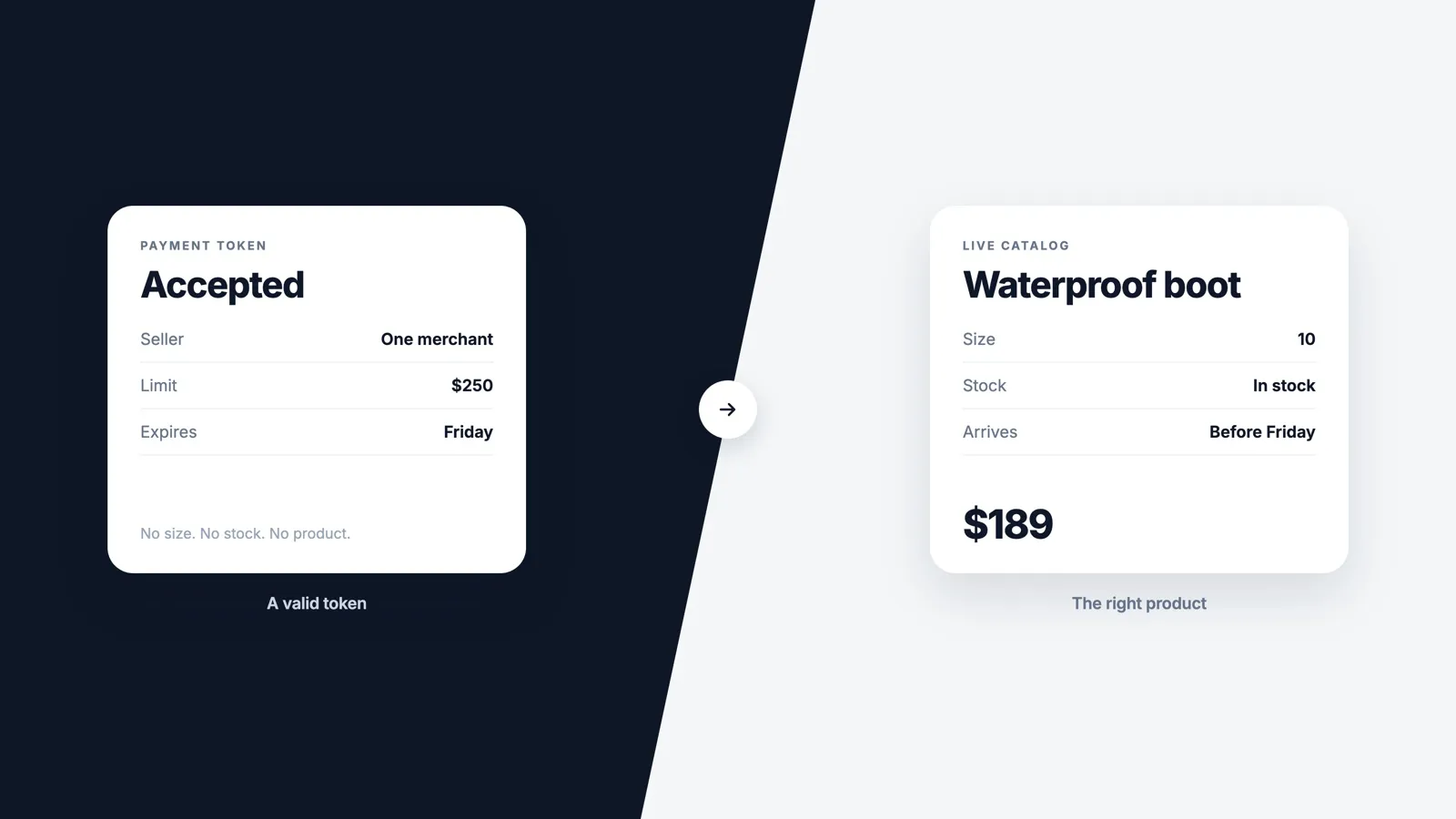
Consider a shopper asking for waterproof hiking boots in size 10, under $250, delivered before Friday. The agent needs to identify the right variant, check availability and understand the delivery promise. Checkout then needs an authoritative total, including shipping and taxes, before the appropriate purchase authorization can be applied.
A valid payment credential cannot establish all those product facts by itself. If the agent selected the wrong size or relied on stale stock information, a technically successful payment still produces a bad order.
Miebach made a similar distinction on Mastercard’s call: widespread use of Agent Pay would not automatically make every merchant discoverable. He described catalog access as a separate part of the work still required.
That is where SuggestAPI fits. SuggestAPI sits in front of an existing search system, interprets natural-language requests, preserves context through comparisons and refinements, and returns structured results that applications and AI agents can use. For commerce, that supports the path from discovery to a merchant-owned checkout handoff.
It is a discovery role, not a claim to issue payment tokens, process card transactions or replace a payment network’s authorization controls. Understanding a shopper’s request also does not substitute for their explicit permission to pay.
The merchant needs both parts to work: reliable product discovery and a controlled transaction.
The payment infrastructure is advancing. The catalog still has to answer.
Mastercard, Visa and Stripe are making agentic checkout more concrete through network tokens, scoped payment permissions, agent identification and records of buyer intent. Some capabilities are already being used; others remain in pilots or previews. The announcements should not be read as universal availability.
Adoption is also early. On Mastercard’s October call, Miebach described impressive weekly growth in agentic transactions while saying the numbers were not yet significant overall. Holiday shopping was an expected adoption driver, not proof that agent-led buying had already become mainstream.
For merchants, payment readiness and discovery readiness need to progress together. An agent should be able to find a current product, explain why it matches the request, and reach checkout without losing the shopper’s requirements.
Explore SuggestAPI to connect the search you already run to structured, intent-aware discovery for people, applications and AI agents.