

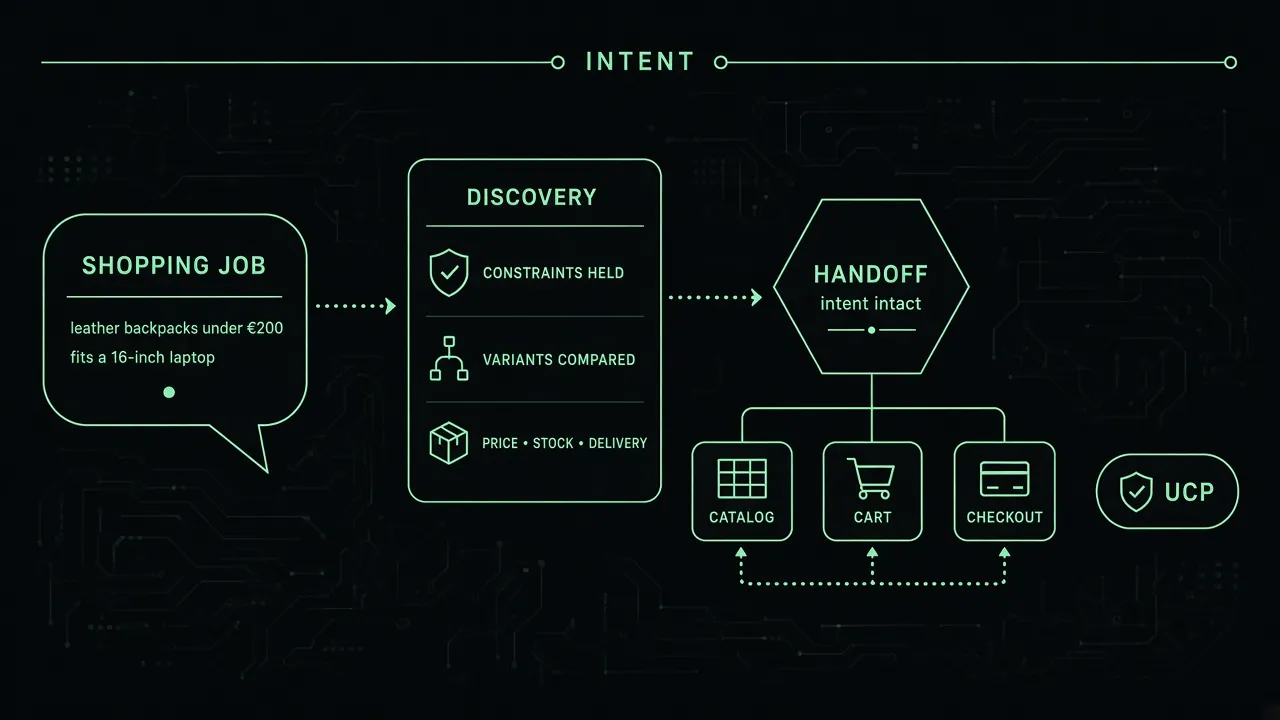
Summary. Shopify’s catalog, cart, checkout, and UCP work points to a new standard for retail. Discovery has to preserve shopping intent from the first question to the handoff.
An AI shopper rarely starts with a keyword. It starts with a job to get done.
“Find five leather backpacks under €200 that fit a 16-inch laptop.” “I need waterproof running shoes in size 43 that can arrive this week.” “Show me black linen trousers in medium, but only the relaxed ones.”
There’s a lot packed into each of those requests. Budget. Use case. Fit. Timing. A few non-negotiables. The product name is only part of the picture.
That is why Shopify’s recent agentic-commerce work deserves attention. Its public architecture now covers catalog discovery, carts, checkout, and order tracking, with the Universal Commerce Protocol (UCP) giving agents and merchants a shared way to transact. Shopify’s developer docs describe global catalog search, merchant-specific catalog search, cart building, checkout, and buyer handoff as parts of one connected flow. [2]
The LinkedIn post that started this conversation lays out six related layers, from catalog MCPs to a broader Shop experience. [1] Useful framing. But the labels are already moving. Shopify has migrated legacy Storefront MCP catalog and cart tools into UCP-based endpoints and separate catalog, cart, and checkout capabilities. [3]
The names will keep changing. The underlying shift will not: an agent has to hold on to the shopper’s intent from the first question through to the purchase.
This is a buyer journey, not a pile of integrations
It’s easy to look at Global Catalog MCP, Storefront Catalog MCP, Cart MCP, Checkout MCP, UCP, and consumer shopping surfaces as separate technical projects. From the shopper’s side, though, it is one continuous experience.
They ask a question. An agent finds a few options. The shopper narrows the field, asks what makes one better than another, then puts something in a cart. Eventually, there is a payment moment. Maybe the person takes over there. Maybe a trusted agent finishes the flow. Later, the same person might ask where the order is.
Shopify’s agent documentation follows that path. Agents can search the Global Catalog across Shopify merchants or scope their search to one Storefront Catalog. As the conversation develops, they can build and revise carts, then create a checkout. Merchants can require a handoff for payment, while trusted agents may be permitted to complete checkout directly. [2]
That is not just a fresh way to package APIs. It raises the bar for product discovery.
A query is not the same as a shopping job
Old-school on-site search tends to reset with every new query. A person types “hiking boots,” clicks filters, opens several tabs, and does the hard comparison work in their own head.
An agent that is actually helpful needs a better memory. It should remember that the shopper is traveling to Iceland in October, has a $250 ceiling, prefers ankle support, and doesn’t want a pair that takes weeks to break in. It needs to separate what the shopper told it from what the catalog says. And it cannot drop the thread when the next question is, “Which of these dries faster?”
That is the gap between matching a phrase and holding a shopping job.
It also makes product data a commercial concern, not a background clean-up task. Shopify says agents rely on structured information such as titles, descriptions, images, pricing, inventory, and shipping when deciding what to surface. The company reported eightfold year-over-year growth in AI-driven traffic to Shopify stores in Q1 2026, alongside nearly thirteenfold growth in orders from AI-powered searches. [4]
Those are Shopify’s numbers, not a promise for every store. Still, the trend points in one direction. A thin product record is no longer only a poor search result. It can keep a product out of a recommendation before a shopper ever sees it.
Make product data capable of answering the next question
An agent-ready catalog is not stuffed with more copy. It has the facts people ask for after the first recommendation.
Take a backpack. The useful details might be dimensions, laptop sleeve size, material, weight, warranty, carry-on fit, current stock, and the difference between water-resistant and waterproof. In apparel, fit, fabric composition, stretch, rise, inseam, variant-level color availability, care instructions, and return conditions can make or break a recommendation.
The same pattern applies to every category. Price must be current. Availability must be current. Delivery details and the rules that shape checkout must be dependable.
A simple test helps. Start with the twenty shopping jobs customers bring to your business most often, not the twenty keywords they type most often. Then see whether the catalog can support a clear answer:
- Can an assistant retrieve the right products without losing the important constraints?
- Can it explain why one option suits the shopper better than another?
- Can it compare variants with facts rather than generic marketing language?
- Can it keep price, stock, and delivery details accurate while the shopper changes the brief?
- Can it hand the person to the correct cart or checkout state without asking them to start again?
If the answer is no, another agent channel will not solve the problem. It will show the cracks sooner.
UCP can carry the transaction. It cannot understand the shopper by itself.
UCP is a meaningful part of the picture because it avoids rebuilding cart and checkout behavior for every new assistant. Shopify calls it an open standard, co-developed with Google, for connecting agents and merchants across discovery, checkout, payment, and post-purchase steps. It can run through REST, GraphQL, MCP, or A2A without changing the core commerce logic. [5]
That is helpful infrastructure. But a protocol cannot decide what someone means by “polished enough for a client dinner but warm enough for an outdoor walk.” It cannot turn missing product fields into a sound comparison. And it cannot recover intent once each refinement has been treated like a brand-new search.
Merchants still need a discovery layer that understands the job, keeps it alive through the conversation, and turns it into structured retrieval and comparison.
Keep the stack you trust. Add a better memory for discovery.
Most retailers do not need to replace the search engine or checkout they have already invested in. They need those systems to work when discovery begins in a chat, a copilot, or a shopping agent.
That is where SuggestAPI fits. It keeps the shopping job intact through Find, Compare, Recommend, and Handoff, while the merchant’s search, catalog, and checkout stay in place. Someone can begin with a fuzzy request, refine it in natural language, and keep moving without the system treating each follow-up as a reset.
For the merchant, one source of product truth can support a person browsing a collection page, an assistant answering a follow-up question, or an agent preparing a purchase path. The surface changes. The shopping job should not.
Shopify’s work is a clear sign that this is becoming infrastructure, not a side experiment. The retailers that come out ahead will not be the ones that collect the most protocol names. They will be the ones whose products can be found, compared, trusted, and handed off when a real buyer starts with a question instead of a search box.
See how SuggestAPI keeps the shopping job intact.