

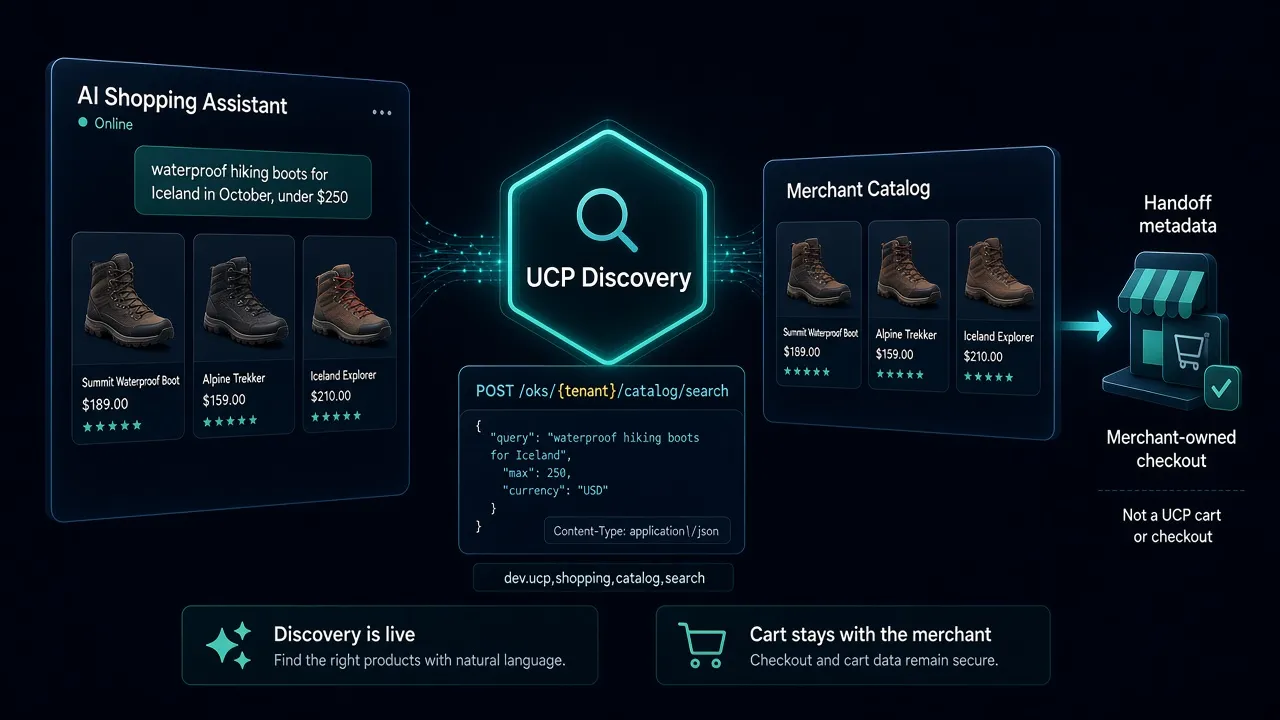
Summary. SuggestAPI helps agents carry shopping intent into product discovery and a merchant-owned handoff. Here is what is live today, what UCP enables, and what comes next.
A shopper asks an assistant for waterproof hiking boots for Iceland in October, under $250. That is not a keyword. It is a shopping job with weather, budget, purpose, and fit tucked inside it.
An agent can answer the first part of that request by finding products. The harder part is preserving the thread when the shopper wants to act. They should not have to repeat the search on a merchant’s site, hunt down the same variant, and rebuild the context the conversation already established.
That is where the Universal Commerce Protocol, or UCP, is useful. It gives agents and commerce systems a common way to exchange the information that moves a shopper from discovery toward a purchase. Google is adopting UCP for commerce actions on AI Mode and Gemini. Shopify has implemented UCP cart and checkout capabilities for agents. [1] [4]
But the protocol should not tempt anyone into overstating what a product does. Today, SuggestAPI is the Knowledge / Agent Gateway for discovery and handoff. It is not a UCP cart or checkout provider. It helps agents hold shopping intent, find relevant products, and hand a shopper back to a merchant-owned destination. Add-to-cart, persisted cart management, checkout, and payment remain outside SuggestAPI’s current UCP scope.
That boundary is deliberate. It keeps the product honest, keeps merchants in control, and leaves a clear path for future commerce capabilities when the underlying integrations are ready.
What SuggestAPI supports today
SuggestAPI’s UCP implementation is focused on tenant-scoped catalog discovery. A tenant can expose a UCP profile at /.well-known/ucp or /oks/{tenant}/.well-known/ucp. That profile advertises the dev.ucp.shopping.catalog.search capability. Agents can then search the tenant’s catalog through POST /oks/{tenant}/catalog/search.
In plain terms, an agent can use SuggestAPI to find products in the merchant’s catalog while keeping the shopper’s broader request in view. That fits the role SuggestAPI already plays: preserve the job behind the query through finding, refining, comparing, recommending, and handing off, without asking a merchant to replace the search and catalog systems it already uses. [6]
SuggestAPI can also return handoff metadata for known products, including a merchant cart or checkout URL where that information is available. The handoff itself belongs to the merchant. SuggestAPI does not create or persist a cart, call a commerce platform’s cart API, verify live inventory, or process a checkout on the merchant’s behalf.
That distinction deserves to be clear in the copy, product UI, and implementation notes. A useful handoff says, “Here is where the shopper can continue with this product.” It does not imply, “We created the merchant’s cart,” unless that is actually true.
Why discovery is still the right place to start
AI shopping conversations do not arrive neatly packaged as product IDs. Shoppers start with a purpose, then add constraints as they go: a size, a color, a deadline, a budget, a use case, perhaps a follow-up question after comparing two options.
Merchants already have systems that are good at different pieces of the journey. Their search platform may be Algolia, Typesense, Elasticsearch, Meilisearch, Shopify, or a custom catalog. Their checkout has rules for taxes, shipping, promotions, loyalty, fraud, payments, and fulfillment. Replacing that stack would be a bad bargain just to show up in a new agent surface.
SuggestAPI sits at the discovery layer. It gives agents structured access to products and keeps the shopper’s intent from getting flattened into a single last-query search. Then it hands the shopper back to the merchant’s existing purchase path. That is useful today, even before an agent can build and manage a cart through SuggestAPI.
A UCP handoff is not only a redirect. It is the moment where the context gathered during discovery is converted into a clear, merchant-owned next step.
UCP can carry the journey farther than SuggestAPI currently does
The wider UCP ecosystem includes cart and checkout capabilities, though those are separate from SuggestAPI’s live catalog-search implementation.
Google’s Cart API supports a specific cart-transfer route. When a shopper elects to transfer a cart from a Google surface, Google calls a merchant’s CreateCart endpoint with the selected line items. The merchant’s system returns a continue_url that directs the shopper to a pre-populated cart or checkout on the merchant’s own site. Google’s Cart API does not process payment or own the full purchase lifecycle. [2]
To participate in that flow, the merchant publishes a UCP profile at /.well-known/ucp, advertises the dev.ucp.shopping.cart capability, and supplies the endpoint that will receive cart requests. Google is rolling out Merchant Center onboarding and sandbox access in phases. Technical implementation is one part of readiness; program participation is another. [3]
SuggestAPI does not currently advertise dev.ucp.shopping.cart, expose Google’s CreateCart endpoint, or operate a merchant’s UCP cart endpoint. Therefore, Google cannot treat a SuggestAPI host as the merchant cart destination through the current product.
Shopify takes a different approach. Its Cart MCP implementation supports creating, retrieving, updating, and canceling a cart while the buyer is still shopping. The Cart MCP response can include a continue_url that sends the buyer to the merchant’s storefront. When the buyer is ready to purchase, Shopify’s Checkout MCP can create a checkout from the cart and return its own merchant handoff URL. [4] [5]
SuggestAPI does not currently call Shopify Cart MCP or create carts on Shopify, BigCommerce, WooCommerce, Magento, or custom commerce platforms. For a Shopify merchant, SuggestAPI can still help an agent discover the right product and then hand the shopper to the merchant-provided path. The native Shopify cart and checkout flow remains separate.
Similar words, very different claims
Agentic commerce language tends to blur together. A few terms look interchangeable in a slide deck, yet describe very different technical commitments.
| Capability | What it means | SuggestAPI status today |
|---|---|---|
| Catalog search | An agent searches a merchant’s product catalog through UCP. | Live: dev.ucp.shopping.catalog.search for tenant-scoped discovery. |
| Product handoff | The agent gives the shopper a merchant-provided cart or checkout destination for a known product. | Live as handoff metadata: no cart is created or stored by SuggestAPI. |
| UCP cart transfer | A UCP Cart API implementation receives line items, creates a merchant cart, and returns continue_url. | Not implemented: SuggestAPI does not expose dev.ucp.shopping.cart or CreateCart. |
| Shopify Cart MCP | An agent creates and manages a cart through Shopify’s native UCP interface. | Not implemented by SuggestAPI: Shopify’s native capability remains separate. |
| Checkout and payment | A purchase session collects the required details and completes the order. | Out of scope: merchant checkout and payment stay with the merchant. |
The table is not a caveat buried in small print. It is the product position. Handoff is valuable precisely because it does not claim to be more than it is.
What a useful handoff looks like
Take the hiking-boots request again. SuggestAPI helps the agent retain the shopper’s constraints and search the merchant’s catalog. The agent identifies a suitable product, explains why it fits, and provides the next destination the merchant has made available.
The shopper continues on the merchant’s site. That site owns the familiar work of commerce: selecting an exact sellable variant, verifying stock, calculating the final total, applying eligible promotions, collecting payment, and confirming the order.
This is not the end state of agentic commerce. It is a sensible operating point. Merchants can make discovery accessible to agents without first rebuilding their cart and checkout infrastructure. Agents can become more helpful without taking responsibility for the highest-risk parts of a transaction.
The road ahead: cart orchestration is a separate build
A future cart capability would need more than a new endpoint name. It would require reliable product and variant mapping, live availability checks, provider-specific cart adapters, idempotency for retries, lifecycle handling for cart expiry, and clear error behavior when a requested item cannot be fulfilled. It would also need its own observability model. A discovery event is not a cart-created event, and a cart-created event is not revenue.
That work should be treated as a planned product capability, not implied by today’s Knowledge / Agent Gateway. When it exists, it can be described as cart orchestration or a commerce gateway. Until then, those phrases are architecture and roadmap language, not a shipped promise.
The same restraint applies to measurement. SuggestAPI and merchant analytics can record discovery-side activity, such as agent access and product search. They should not claim an end-to-end chain of cart creation, checkout handoff, and order completion when SuggestAPI does not own those steps.
A clearer way to prepare for agentic commerce
The first practical move is not to bolt a new checkout onto every agent. It is to make product discovery dependable.
Give agents an accurate catalog surface. Preserve the shopper’s job as the conversation evolves. Provide an honest, merchant-owned destination when it is time to continue. Then build deeper cart and checkout integrations only when the product, provider support, and operational responsibilities are actually in place.
That is the approach behind SuggestAPI’s current UCP support: make discovery agent-ready, keep the merchant stack underneath, and make the handoff useful without pretending the journey is already complete.
Frequently asked questions
Does SuggestAPI currently provide UCP cart or checkout?
No. SuggestAPI is the Knowledge / Agent Gateway for discovery and handoff. It does not advertise dev.ucp.shopping.cart, expose CreateCart, or process checkout or payment.
What UCP capability is live today?
Tenant-scoped catalog discovery. A tenant can expose a UCP profile at /.well-known/ucp or /oks/{tenant}/.well-known/ucp and advertise dev.ucp.shopping.catalog.search. Agents search with POST /oks/{tenant}/catalog/search.
What does a SuggestAPI handoff include?
Handoff metadata for known products, including a merchant cart or checkout URL when that information is available. SuggestAPI does not create or persist a cart, verify live inventory, or check out on the merchant’s behalf.
Can Google treat SuggestAPI as the merchant cart destination?
Not through the current product. Google’s Cart API expects a merchant CreateCart endpoint behind the advertised UCP cart capability. SuggestAPI does not expose that endpoint.
Does SuggestAPI call Shopify Cart MCP?
No. For a Shopify merchant, SuggestAPI can help an agent discover the right product and hand the shopper to the merchant-provided path. Native Shopify cart and checkout remain separate.
References
- Google for Developers, “Getting started with Universal Commerce Protocol on Google”
- Google for Developers, “Cart API implementation, Universal Commerce Protocol 2026-04-08”
- Google Merchant Center Help, “How to onboard to the Universal Commerce Protocol in Merchant Center”
- Shopify, “Carts and checkout for agents”
- Shopify, “Cart MCP server”
- SuggestAPI: Turn shopping intent into products, wherever people start