

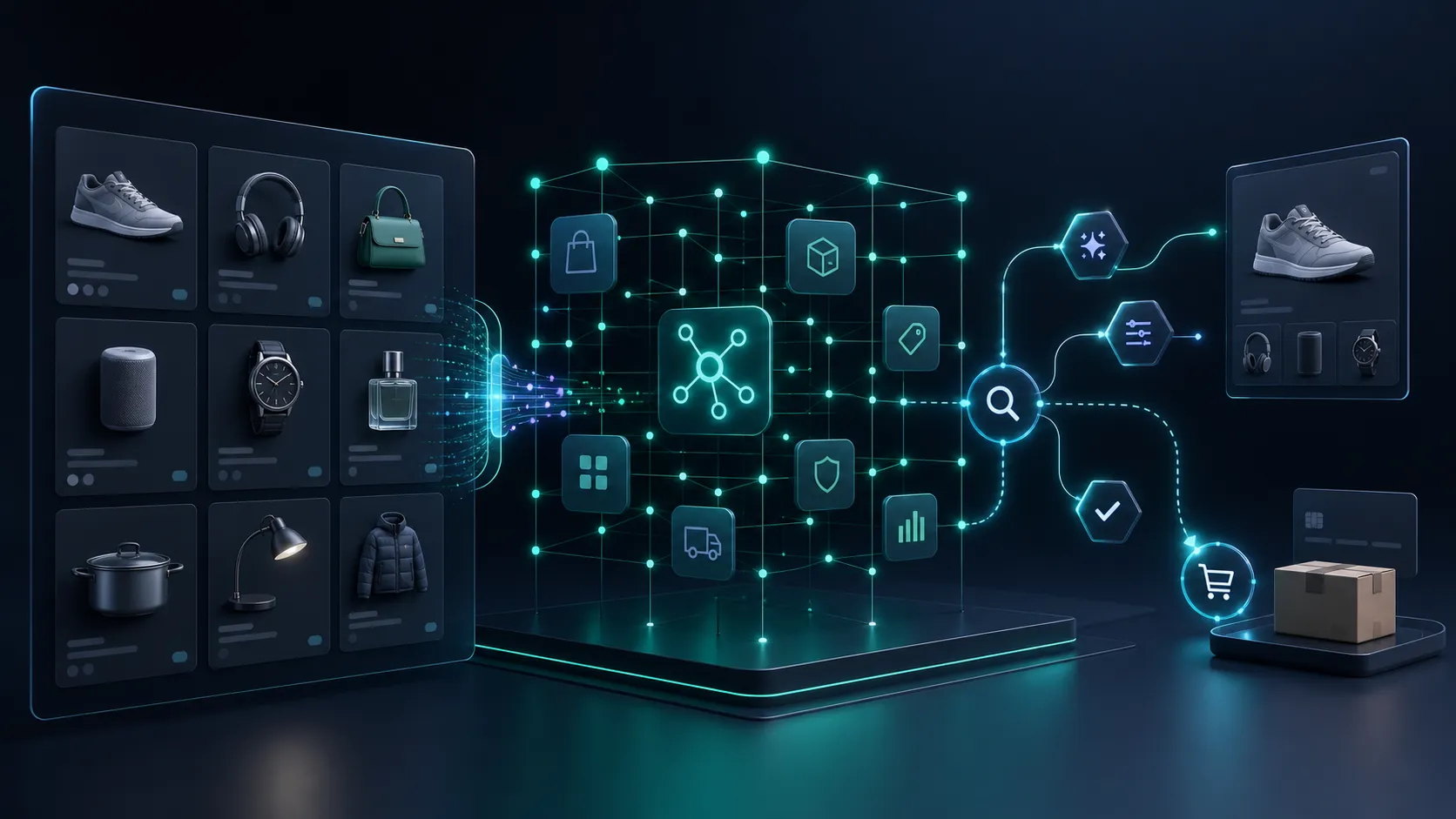
Summary. Shoppers still buy on your storefront. Discovery, the shortlist, and measurement have moved into AI conversations before the click.
For twenty-five years, discovery on the web had one shape. Somebody typed two or three words into a box. You matched those words against a catalog. A results page did the rest.
Google taught shoppers to think in keywords. Retailers built teams, budgets and three-year roadmaps around them. Whole careers, honestly.
That shape is breaking.
Queries got longer. Similarweb's 2026 data shows it clearly, and it isn't because people type more when they're in a hurry. It's because they've stopped doing the interpretation themselves. Keyword-style searching was a habit built around a matching engine. Long, conversational queries are a habit built around something people believe can read context.
So when someone types "waterproof hiking boots for Iceland in October under $250, women's size 9," that isn't a keyword. It's a job. And you either understand it or you return a page of boots and hope.
The adoption numbers sit behind the habit. 77.6% of consumers used AI for shopping in the past six months (Search Engine Land, April 2026). Weekly or more often: 43%. Product research leads at 68.5%, with price comparison close behind.
Then the session keeps going after the answer. About six in ten ChatGPT referrals land on a homepage instead of a deep page. Different visitor than the one organic search trained you for. They've usually made up their mind before they arrive.
Keyword search didn't get worse. It lost the part of the journey where intent gets formed.
The decision happens before the click
For most of e-commerce history, the narrowing happened on your site. Filters. Category pages. Comparison tables. Reviews. Your site earned the right to that decision because it was the only place with the data.
Now the narrowing happens in the conversation. By the time someone shows up, the shortlist is done.
Adobe's Q1 2026 numbers make the consequence hard to argue with. March 2025: AI traffic converted 38% worse than non-AI channels. March 2026: 42% better. An eighty-point swing in a year, with revenue per visit running 37% above non-AI traffic.
That's not a channel getting better at sending traffic. That's a channel sending people who already finished shopping.
Which brings up the question worth losing sleep over. When the assistant built that shortlist, what did it find?
Marketing pages? The agent scraped and guessed. Model training data? You're being represented by last year's catalog. Either way, a system you don't control made a call about your products using information you'd never put in front of a customer.
Agents want the boring stuff. Price, size, variant, stock, shipping window, return policy, whatever's on promo this week. Structured. Current. Scoped to the merchant who owns it.
The protocols are converging to carry exactly that. OpenAI's ACP and Google's UCP define how agents talk to catalogs and checkout endpoints. MCP and WebMCP hand agents callable tools instead of scraped HTML. And the compound effect is real: retailers implementing ACP and UCP together see roughly 40% more agentic traffic than single-protocol adopters.
You don't need to bet on a winner. You need to be legible to whoever shows up.
Measurement stopped matching the journey
Discovery moved. Decisions moved. Reporting didn't.
Most e-commerce measurement still runs on sessions, keyword rankings and channel attribution. AI traffic cooperates with none of it. It arrives without a clean referral tag more often than not. Homepage referrals from ChatGPT climbed to 62-63% of referral traffic and stayed there. A good chunk of that ends up filed under "direct, no clear source," which is where teams have historically stopped asking questions.
Citations don't rescue you either. Citation presence in US ChatGPT prompts was around 6.8% in May 2026, up from 1.6% a year earlier. Travel runs highest, near 23%. But a citation isn't a product result. It's visibility. It tells you nothing about whether the catalog returned something a person could actually buy. We've written about that gap before.
So the questions worth asking look different now:
- Did the assistant surface the right product, or just a plausible one?
- Which SKUs show up for the queries that carry your margin?
- Where do shopping conversations die, and did your catalog kill them?
- How many sessions never happened because nobody clicked?
Answer-level questions. You won't reach them from a landing page report.
What this asks of your stack
The reflex is to replatform. New engine, new pipeline, new six-month migration. Wrong move, and the expensive one.
Three changes carry most of the weight.
Hold the intent. A shopping job persists across refinements. Budget, season, constraints, the thing they rejected two turns ago. A keyword matcher dumps all of it after one query. A discovery layer keeps it and passes a better query downstream to the engine you already run.
Make the catalog legible. Live prices, stock, variants and policies, structured and tenant-scoped, without handing your private API keys to a browser client or somebody else's assistant.
Measure discovery, not just the aftermath. What the catalog returned. What the assistant did with it. Where the handoff broke.
And none of it means ripping out Algolia, Typesense, Elasticsearch, Meilisearch, or the search behind your Shopify store.
That's the layer SuggestAPI sits in. Keep your search, catalog and checkout. Add one endpoint in front. Hold the shopping job across find, compare, recommend and handoff, for people and for agents, on the same catalog underneath.
One question to start
Can an AI shopping assistant find your products right now, with today's price and today's stock, and hand off to a checkout you control?
If you can't answer that in a sentence, you've found your first project.
The storefront isn't going anywhere. Checkout, loyalty, fulfillment, the brand experience. All of it still lives on your site, and shoppers still want it there. What moved is the part that used to happen in your search bar. A growing share of the discovery job now happens on ground you don't operate, decided by a system you didn't configure, using catalog data you may not be publishing.
Which looks like a traffic problem. It isn't. It's a data problem in a traffic problem's coat. Worth knowing which one you've got before the next planning cycle starts.