

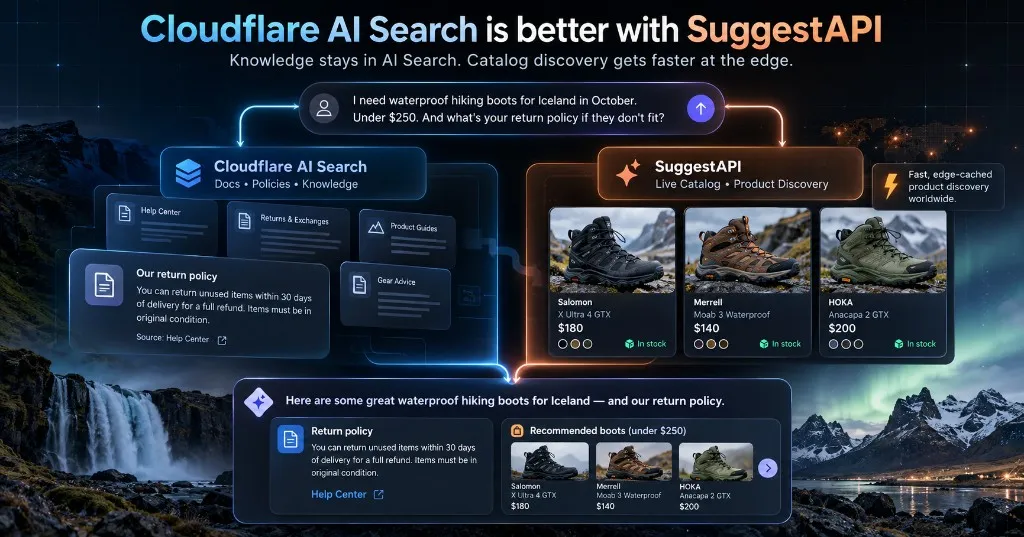
Summary. Cloudflare AI Search is better with SuggestAPI because catalog discovery is faster when it is cached at the edge, while AI Search stays on your knowledge.
Picture someone typing this into an AI assistant:
I need waterproof hiking boots for Iceland in October. Under $250. And what's your return policy if they don't fit?
That's one sentence. It's also two completely different questions wearing the same coat.
One is about what you sell and whether it's in stock. The other is about what your business promises. Answer only the first and the shopper is holding boots with no idea if they can send them back. Answer only the second and they know your policy perfectly, but own nothing.
Cloudflare AI Search is now generally available, and it's very good at one of those jobs. SuggestAPI is built for the other. Most teams will feel pressure to pick. You don't have to.
The short answer to why AI Search is better with SuggestAPI: faster catalog answers, cached at the edge. AI Search can stay on docs and policies. SuggestAPI sits in front of your product search, serves hot queries from the edge, and returns buyable results without dragging every assistant round-trip back to origin.
Why Cloudflare AI Search is better with SuggestAPI
An assistant that has to explain a return policy and find waterproof boots is doing two retrievals in one turn. If the product half is slow, the whole answer feels slow. Shoppers do not care which subsystem was late.
Faster. Cached at the edge. SuggestAPI is a discovery layer in front of the search engine you already run. Repeated suggestion and discovery traffic can be served from edge cache instead of waiting on Algolia, Typesense, Elastic, Meilisearch, or Shopify on every keystroke and tool call. That is the same instinct as a CDN, applied to catalog search: keep the origin as source of truth, pull latency down where traffic repeats.
That speed matters more when you stack layers. Cloudflare AI Search is retrieving sourced passages from your knowledge. SuggestAPI is retrieving live products. Run them in parallel and the assistant can assemble policy plus product without the catalog leg becoming the bottleneck. AI Search stays excellent at what it is for. SuggestAPI makes the commerce half keep up.
You also get the shape of answer each layer is built for. AI Search returns grounded explanations. SuggestAPI returns current titles, prices, stock, variants, and a path to checkout. Together that is a complete shopper reply. Alone, each one leaves a gap.
What Cloudflare AI Search actually does
Cloudflare describes it as a search primitive for your agents. The plain-English version: you give it your content, it lets anyone search that content in natural language, and you don't have to build or babysit the retrieval machinery behind it.
Think help center articles, policy pages, spec sheets, PDFs, internal handbooks, product documentation. Point it at the material and it becomes searchable. Sentry's team called it "a cheat code for building AI," noting even their non-technical folks ship features with it. That tracks. The appeal isn't sophistication, it's that you skip the plumbing.
What the GA release changes is mostly practical. You can build on it in production without wondering if the foundation shifts. Usage-based billing starts November 1, 2026, with included monthly ingestion, storage, and query usage, and Cloudflare says it'll email a reminder the week before. Nothing about the release changes what the product is. It's retrieval over your knowledge, now with a real support commitment behind it.
What SuggestAPI does
SuggestAPI is a discovery layer that sits in front of the search you already run. Nothing gets ripped out. Algolia, Typesense, Elastic, Meilisearch, Shopify, or a SuggestAPI index if you're starting from nothing. It goes in front and improves what happens there.
That means two audiences at once.
For shoppers on your storefront, you get suggestions that survive typos and half-finished thoughts. Someone types "waterproff hikin boots size 11" and still lands on products. Someone describes a trip instead of a product and still gets useful results.
For shopping assistants, you get a catalog they can actually work with. Real titles, current prices, real availability, real variants, pulled from live inventory instead of scraped off a marketing page or remembered from training data that went stale last year. Agents that use SuggestAPI call tools like search, compare, and recommend, and they get product data back. Not a vibe. Not a guess.
One detail that matters more than it sounds: your private search credentials stay private. The assistant talks to SuggestAPI, SuggestAPI talks to your backend. You're not handing API keys to every agent that wanders in.
Where the two meet
Here's the same shopper request, traced through both layers.
The assistant reads the message and splits it without thinking about it. "Waterproof," "Iceland in October," "under $250" is a product request. "What's your return policy if they don't fit" is a knowledge request.
The knowledge half goes to Cloudflare AI Search, which pulls your actual policy language and returns it with a source. The shopper's assistant can now say something specific and true, not a generic guess about how returns usually work.
The product half goes to SuggestAPI, which queries your live catalog and comes back with boots that are waterproof, in the right size, in stock, and under budget. Because it's your catalog, the answer carries a product ID and a path to your existing checkout.
The assistant assembles both halves into one answer and hands the shopper off to buy.
Neither layer could finish that sentence alone. That's not a flaw in either product. It's the shape of the problem.
| Cloudflare AI Search | SuggestAPI | |
|---|---|---|
| Built to answer | Questions about your content | Questions about your catalog |
| Returns | Sourced passages | Buyable products with price and stock |
| Ends with | An explanation | A checkout handoff |
| Feels like | A really good documentation search | A really good storefront search |
| Speed | Retrieval over your knowledge corpus | Edge-cached discovery in front of your catalog search |
Why this matters more than it used to
Search used to be one job. A person typed into a box on your site, and you either helped them find something or you didn't.
Now some of your traffic arrives through an assistant that's doing the typing on someone's behalf. That assistant needs to explain your policies and find your products, often in the same breath, and then get the person to checkout without losing them.
Answers that stop at a citation leave money on the table. We've written about that gap before: being mentioned in an AI answer is not the same as returning a product someone can buy today. Visibility and discovery are related, but they're not interchangeable, and only one of them shows up in revenue.
The flip side is just as real. A storefront that returns products but can't explain anything is a storefront an assistant can't trust with a complicated request. "Is it waterproof?" and "can I return it?" are the questions that decide whether a purchase happens.
What teams usually get wrong
Two mistakes, both cheap to avoid.
Pointing one index at both jobs. Index your policy pages and your product catalog together and you get a search experience that hands shoppers help articles when they're trying to buy, and product cards when they're trying to understand a warranty. These are different retrieval problems and they want different shapes of answer.
Waiting to pick a winner. AI Search isn't competing with SuggestAPI. Cloudflare's own product page reads like infrastructure for platforms, and that's what it is. SuggestAPI assumes you already have search and makes the commerce side of it faster at the edge. They're stacked, not opposed. You can also find our longer comparison on this if you want the direct read.
How to start
Keep the knowledge index you have or stand one up with AI Search. Docs, policies, help center, the material your support team keeps answering the same questions about.
Then put SuggestAPI in front of the search engine you already run and connect your catalog. One endpoint change on the storefront is the whole integration. No replatform, no migration project, no rebuilding checkout.
After that, the question stops being "which one do we choose" and becomes the more useful one: what does a shopper actually need to hear before they buy?
Answer with a policy and a product, and you've covered it.