

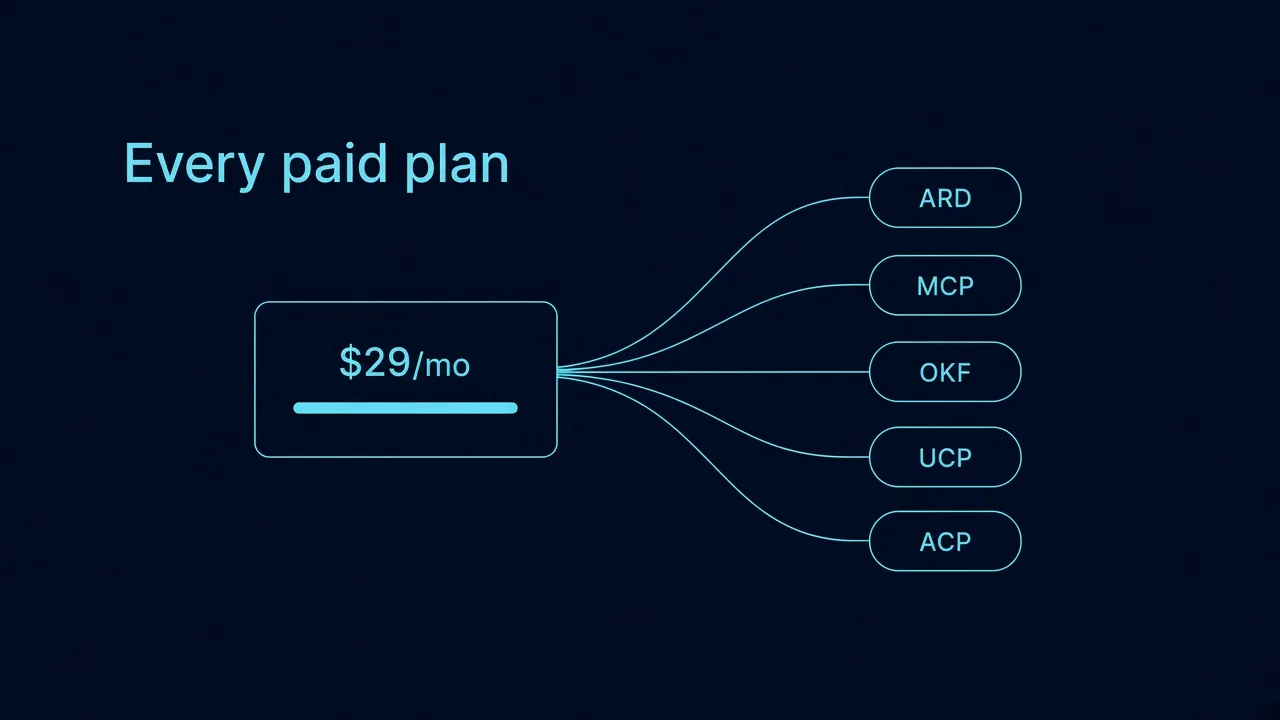
Summary. Search vendors gate agent access behind enterprise contracts. SuggestAPI includes MCP, ARD, OKF, UCP, and ACP on every paid plan, on one request meter.
The short version
- Agent access became a paid add-on at most search vendors. The protocols themselves are open; the glue around them is what gets sold.
- SuggestAPI publishes your catalog, policies, and search surface in every major agent format, on the $29/mo tier and up.
- Shopper searches and agent tool calls draw from one request meter with overage caps, so a crawler spike can't turn into a surprise invoice.
Somewhere in the last eighteen months, agent access became a line item.
Search vendors noticed that "make your catalog readable by AI agents" sounds like a premium capability, so they priced it like one: an enterprise add-on, a gateway license, a six-week professional services engagement. Your storefront search works fine. Your agent endpoint sits in a contract review queue.
That is the protocol tax, and it is strange for one specific reason. None of the underlying protocols are proprietary. MCP is an open spec. ARD is Apache 2.0. OKF is a Markdown convention. UCP and ACP are open standards with public repositories. Nobody is paying a license fee to anyone for the right to speak these formats. What vendors are charging for is the glue: publishing the catalog file, running the server, translating your index into agent-shaped responses, keeping the schema current as the specs move, and metering agent traffic separately from shopper traffic.
Charging for glue is reasonable. Making the glue a separate contract is not. It means the smallest stores, the ones with the most to gain from being findable inside an assistant, are the least likely to be reachable at all.
The protocol tax, in plain terms
Here is what an "agent access" upsell usually contains when you read the order form.
A discovery document that has to live at a well-known path on your domain. A server process that exposes your catalog as callable tools with typed schemas. A structured bundle describing your return policy, sizing notes, and shipping rules in a format an agent can parse without guessing. Commerce endpoints that let an agent build a cart and hand off a checkout. And a second billing meter for the traffic all of that generates.
Five artifacts, one of which (the meter) exists purely because the vendor decided agent requests deserve their own price list.
Five protocols, two jobs
The industry press treats these acronyms as one undifferentiated blob of "agentic." They are not. Three of them are about being found and understood. Two are about getting paid. The formats SuggestAPI publishes are listed on the supported protocols page.
| Protocol | What it standardizes | Origin | What your store has to publish |
|---|---|---|---|
| ARD (Agentic Resource Discovery) | Publishing, discovering, and verifying AI capabilities across domains | Open spec, Apache 2.0, June 2026 | An ai-catalog.json catalog at a well-known path on your domain |
| MCP (Model Context Protocol) | How an agent calls tools and reads resources | Open spec, now widely implemented | A server exposing catalog search, product lookup, and policy reads as typed tools |
| OKF (Open Knowledge Format) | Packaging curated knowledge as linked Markdown with YAML metadata | Google Cloud, v0.1 | A bundle describing policies, sizing, compatibility, and support answers |
| UCP (Universal Commerce Protocol) | The commerce lifecycle: catalog, cart, identity, checkout, orders, bookings | Open standard, January 2026, built on MCP/A2A/AP2 | Catalog, cart, and checkout endpoints that keep you merchant of record |
| ACP (Agentic Commerce Protocol) | Agent-initiated checkout and secure payment credential passing | Stripe and OpenAI, September 2025 | Agent-facing checkout endpoints wired to your existing PSP |
ARD is the front door. Instead of every agent hardcoding every merchant, you publish a catalog under your own domain and registries index it. Ownership of the domain becomes the trust anchor, which is the cleanest identity story anyone has proposed for the agentic web. If you do nothing else, do this.
MCP is the handshake. ARD tells an agent that a capability exists. MCP is how the agent actually calls it: search_catalog, get_product, check_shipping_policy. The quality of those tool descriptions matters more than most teams expect. An agent picks tools by reading them.
OKF is the context layer. Agents do not fail because they cannot find your products. They fail because they cannot find your return window, your battery compatibility table, or the difference between your two nearly identical SKUs. OKF packages that knowledge as linked files with provenance metadata, so the agent can cite it instead of inventing it.
UCP and ACP are the transaction layer. They solve a different problem: letting an agent complete a purchase without you rebuilding checkout for every assistant. UCP covers the full lifecycle and keeps you merchant of record. ACP is narrower and payment-centric, built around tokenized credentials so an agent never touches raw card data. They overlap, both are early, and supporting both is cheaper than betting on one.
What "included" has to mean
A checkbox is not support. For these protocols to be genuinely included rather than technically mentioned, five things have to be true on day one.
Published. Your ARD catalog is served from your domain, signed with metadata a registry can verify, and updated when your catalog changes. Not a static file someone FTPs quarterly.
Translated. Your existing index becomes an MCP server with tool schemas an agent can actually choose between. The mapping runs both ways: shopper queries and agent calls hit the same relevance layer, so an agent asking for "waterproof trail shoe under 150" gets the same quality of answer a human does.
Documented. An OKF bundle generated from the policy and product content you already have, versioned alongside it, so the agent's answers about returns and compatibility track the current truth.
Transactable. UCP and ACP endpoints in front of your existing cart and payment service provider. No re-platforming, no new merchant account.
Metered honestly. One request pool. A capped overage. A dashboard that shows which share of traffic came from agents.
That last one deserves its own section, because it is where most "unlimited agent access" claims fall apart.
Why one meter beats five
Picture a Tuesday. A shopper types "blue running shoes" into your storefront suggest box. Ten seconds later, an assistant calls search_catalog with the same intent on behalf of the same shopper. Identical work: parse intent, hit the index, rank, return. Charging two different rates for it is an accounting decision, not an engineering one.
SuggestAPI runs one meter. Storefront suggestions, agent tool calls, catalog reads, and policy lookups all draw from the same pool, so capacity planning stays a single number instead of a spreadsheet of protocol-specific commitments. Overage caps are on by default, which matters more than it sounds. The first time an agent framework decides to re-crawl your catalog every four minutes, you want a ceiling, not an apology email and a $4,000 invoice.
You pay for two things: request volume and catalog size. Not for the right to answer an agent.
The comparison, without the hedging
| Capability | Typical search vendor | SuggestAPI |
|---|---|---|
| MCP endpoint | Enterprise add-on | Included ($29/mo+) |
| ARD catalog | Not supported | Included ($29/mo+) |
| OKF bundle | Manual custom wrappers | Included ($29/mo+) |
| Agent discovery surface | Paid tier–gated | Included ($29/mo+) |
| UCP / ACP checkout | Custom integration project | Included ($29/mo+) |
| Agent traffic metering | Separate contract, or unmetered | Same request meter |
| Overage protection | Varies, often none | Capped by default |
What this does not fix
Three honest caveats, because a launch post that claims everything is a launch post nobody forwards to their CTO.
Publishing a catalog does not earn trust. ARD gives registries a way to verify you own your domain. It does not make your product data accurate, your stock counts real, or your return policy humane. Agents get better at reading merchants; merchants still have to be worth reading.
Platform participation is separate from protocol support. Shipping ACP endpoints does not automatically put you inside ChatGPT. OpenAI runs its own onboarding for that. UCP adoption is spreading across platforms, but it is still early and uneven. What protocol support buys you is readiness: when a platform opens a slot, you are not starting a six-week project.
Two of these specs are months old. OKF is at v0.1. ARD shipped in June. Expect schema churn, and expect your wrapper to need maintenance. That maintenance is exactly the work SuggestAPI absorbs, which is a fair thing to charge for. It is not a fair thing to charge five times for, once per protocol.
What it looks like on Monday
Point SuggestAPI at your existing engine: Algolia, Typesense, Elasticsearch, or Meilisearch. Keep your stack, your cart, your PSP. The layer caches responses at the edge (roughly 30ms against 280ms uncached in our benchmarks), rewrites queries, recovers typos, and emits the agent-facing surfaces from the same config.
Live in about thirty minutes. No migration, no re-index, no separate agent contract.
FAQ
Do I have to rebuild my storefront or checkout?
No. SuggestAPI sits in front of your current search engine and your current cart. The agent-facing endpoints are additions, not replacements.
What counts as a request?
One call into the layer. A storefront suggestion, an agent tool call, a catalog read, and a policy lookup all count the same way and draw from the same pool.
What happens when an AI crawler hammers the endpoint?
Overage caps stop the spend at the ceiling you set. You will see the traffic in the dashboard before you see it on a statement.
Which search backends are supported?
Algolia, Typesense, Elasticsearch, and Meilisearch today. Because the layer is in front of the engine, swapping engines later does not require touching your app.
Is it worth publishing OKF and ARD while the specs are still moving?
Yes, for the parts that are cheap and additive. A catalog file and a knowledge bundle cost you nothing at the margin, and they are the units agents will index. Betting your checkout roadmap on a v0.1 spec is a different decision, and we would tell you to wait on that one.
The point
Every paid tier speaks AI. Not because we are generous, but because a search layer that only some of your traffic can reach is not a search layer. It is a toll booth.
Charge for volume. Charge for catalog size. Do not charge for the right to be found.