

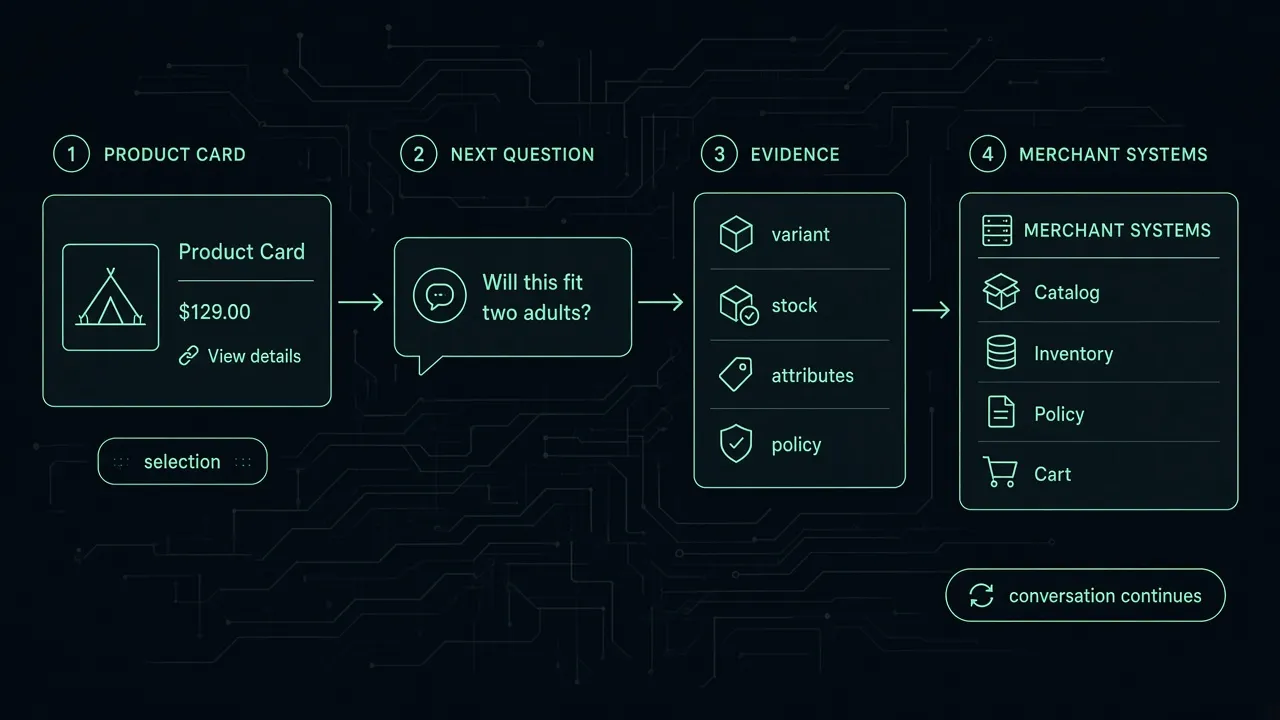
Summary. Claude commerce experiences and OpenAI Sponsored Agents point to the same shift: product cards now need the context to sustain a shopper conversation.
A shopper asks for a waterproof tent for two people under $250. The assistant returns a handful of products. Images, prices, ratings, perhaps a badge. It looks like a tidy answer.
It isn’t, not for long.
Will this fit two adults comfortably? Is it lighter than the other one? Can it arrive before Friday? Is the lower price a real compromise, or just a different color?
That is where shopping starts to get interesting. And it is where the product card has a new job.
Anthropic’s Claude for commerce reference blueprint treats products and comparisons as UI components inside a conversation. Its shopping agent can search a catalog, compare finalists, show product and comparison views, answer policy questions, fill a cart, and hand off to checkout. [1] OpenAI is bringing a related interaction model to paid discovery with Sponsored Agents. After clicking an ad in ChatGPT, a person can choose to start a clearly labeled conversation with a business-sponsored agent, ask follow-up questions, and visit the merchant when ready. OpenAI says that conversation is distinct from both ChatGPT’s independent answers and the user’s original conversation. [2]
Different companies. Different entry points. The shopper experience is starting to rhyme:
Show me something. Explain why it fits. Let me ask. Help me decide.
The card now opens the conversation
A conventional product card does a useful but contained piece of work. It helps someone scan a results page and decide what deserves a click. It is made for selection.
In a conversational surface, though, a card makes a claim: this product is worth considering for the job you described. The very next question puts that claim under pressure. If the commerce stack cannot supply the evidence, the experience slides into generic copy, stale facts, or an early trip to a product-detail page.
A better-looking card will still win attention. It will not explain the trade-off between two products unless the product data underneath it can explain that trade-off too.
The product on screen has to stay connected to the shopper’s job, the exact variant shown, current commercial facts, and the details that separate it from the alternatives. Otherwise, every follow-up becomes a fresh search or a chance for the model to guess.
What a card needs for the next turn
The answer is not to squeeze a product-detail page into every card. It is to make the information behind the card available in a form the assistant can retrieve, compare, and ground in when the shopper asks.
| Shopper question | Context the assistant needs | Merchant system that should remain authoritative |
|---|---|---|
| “Is this right for my trip?” | Use case, dimensions, materials, compatibility, constraints, and the reason it matched | Catalog, PIM, product content |
| “How does it compare with that one?” | Normalized attributes, meaningful comparison fields, and known trade-offs | Catalog, comparison logic, merchandising rules |
| “Can I get it by Friday?” | Variant-level stock, serviceability, delivery promise, and price | Inventory, fulfillment, pricing |
| “What if it is not right?” | Return eligibility, exclusions, warranty, and support terms | Policy and order systems |
| “Add the blue one in medium.” | A stable product ID, variant IDs, option availability, and current price | Catalog and cart |
That is the gap between a card that shows a product and one that can carry a decision forward.
Very little of this is generated sales language. Most of it is practical, occasionally unglamorous data. Which variant is in stock. Whether a sleeping bag packs small enough for carry-on luggage. Whether a return is accepted after use. Whether the recommended table really seats six, or only four comfortably.
A shopper may never see all of those fields at once. The agent still needs access to them. A conversation is not one response; it is a series of requests for proof.
Paid and organic remain separate. The interaction is converging.
OpenAI is explicit that a Sponsored Agent conversation is clearly labeled and separate from ChatGPT’s independent answers. [2] That distinction matters. Paid placement should not be passed off as an organic recommendation.
But the interaction after a person chooses to engage is getting familiar. In both cases, the shopper sees a product, asks whether it fits, compares options, and wants a trustworthy path to the merchant. A good interface does not break that sequence. It lets the shopper keep going.
For merchants, that moves the product card from finish line to starting line. The card has to identify the product accurately, hold on to the shopping job, and reach the systems that can answer the question that follows. A campaign can earn the first moment of attention. It cannot create a credible answer to “Will this work for me?” when the relevant product and policy data are missing.
Build a chain of evidence, not a prettier tile
For a product card to survive the next question, five things need to be in place.
- A stable identity. Keep product and variant IDs attached to the card so inventory, cart, and checkout actions apply to the exact item the shopper saw.
- Live commercial facts. Price, stock, availability, and delivery details should come from current systems, not copied descriptions or a model’s memory.
- Comparable attributes. Identify the fields shoppers actually use to choose within a category, then normalize them so an agent can explain a real difference instead of reciting unrelated specifications.
- Grounded supporting context. Make product detail, returns, compatibility, and fulfillment rules retrievable from their source systems. If the model does not have the fact, it should not make one up.
- A preserved shopping job. Retain the budget, intended use, constraints, and preferences that created the shortlist. A follow-up should refine the job, not reset it.
This is the work behind agent-ready commerce. It is also why putting a chat box over a catalog rarely produces a useful shopping assistant. The agent needs a dependable way to find current products, use the right comparison fields, answer from merchant policy, and hand off without dropping the thread.
SuggestAPI is built for that discovery layer. It sits in front of the catalog and search stack a merchant already runs, keeps the shopping job available across refinements, and returns structured, current product candidates that an agent can compare, recommend, and hand off to merchant-owned checkout. It does not replace the source systems. It gives shoppers, storefronts, and agents a consistent way to reach them. [3]
For a Claude implementation, the division of work is clean: Claude handles the conversation; SuggestAPI turns the job into ranked products; the merchant remains the source of truth for catalog, inventory, cart, and checkout. [4]
The next card has to explain itself
The product card still matters. It gets the right item onto the screen at the right time. But its work no longer ends there.
As shopping shifts into conversation, the card needs enough connected context to survive curiosity: the question about fit, the cheaper alternative, the constraint that appears two turns later, and the final request to buy.
The better card will not be the one with the most fields. It will be the one that gives the assistant an honest, current basis for saying why a product fits, where it does not, and what the shopper ought to look at next.