

Summary. Learn what a PIM is, when an e-commerce business needs one, and how centralized product data supports discovery, conversion, and growth.
Product information used to be a housekeeping job. A title here, a specification there, a few images, then publish the product page and move on.
That model breaks down quickly once a catalogue grows.
The same product details now need to appear on an e-commerce site, marketplace listings, search feeds, social catalogues, retailer portals, email campaigns, customer-service tools, and AI-assisted shopping experiences. A missing material, an inconsistent size field, or an old image can travel farther than it used to.
For e-commerce teams, product data is no longer just page content. It is operating infrastructure.
That is where a Product Information Management system, usually called a PIM, comes in.
What is a PIM?
A PIM is a central place for collecting, managing, enriching, approving, and distributing product information.
It brings together the details that tend to live in different places: supplier files, spreadsheets, asset folders, ERP records, merchandising notes, compliance documents, and content written by the marketing team. Instead of correcting the same product information in several systems, a team improves it once at the source and then sends approved data to the places where it is needed.
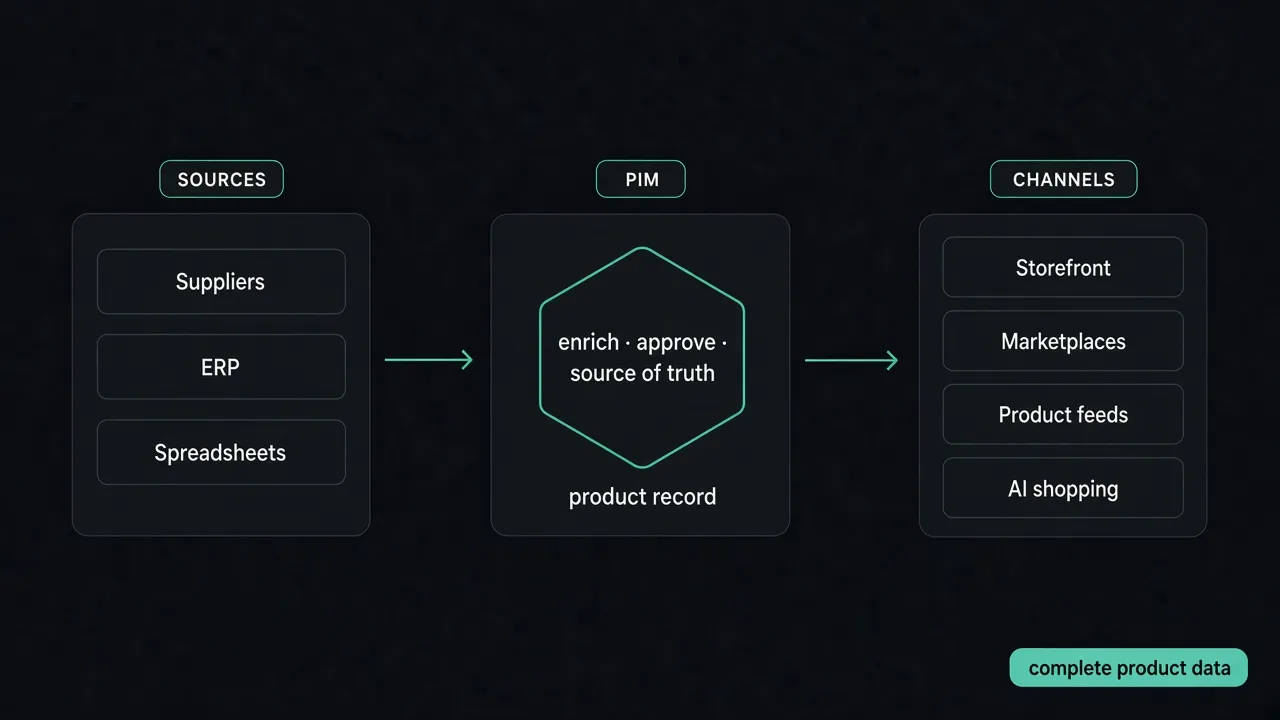
A simple flow looks like this:
Suppliers, internal systems, and content teams → PIM → e-commerce site, marketplaces, ad feeds, retail partners, and other channels
A PIM does not replace an online store, an order-management system, or an inventory system. Its job is narrower, but important: make product information complete, consistent, and usable before it reaches those downstream systems.
Why PIM matters now
Shoppers rarely discover products in one place.
They may begin with a search query, compare options on a marketplace, encounter a product in a social ad, and return to the brand’s own website to buy. Each touchpoint relies on product data to explain what the item is, who it is for, what makes it different, and whether it meets a specific need.
AI-assisted discovery adds another layer. When a customer asks a shopping assistant for a compact carry-on bag with a laptop sleeve, or a fragrance-free moisturizer for sensitive skin, the system needs clear attributes to make a useful recommendation. Vague titles and thin descriptions leave it guessing.
The problem is not limited to AI. Poor product data creates familiar commercial issues:
- Products are harder to find through search and filters.
- Merchandising teams spend time chasing missing information.
- Customers see different details in different channels.
- New product launches stall while people reconcile spreadsheets.
- Marketplace and retail-partner listings are rejected or underperform.
- Support teams answer avoidable questions about dimensions, compatibility, ingredients, materials, or care.
None of these failures is dramatic on its own. Together, they slow growth.
What a PIM actually does
A useful PIM supports a handful of disciplined product-data practices.
Centralizes product information
A PIM gives the business a defined source of truth for titles, descriptions, specifications, dimensions, images, videos, certificates, taxonomy, relationships, and channel-ready attributes.
That does not mean every system disappears. Supplier, inventory, and finance systems can still retain their own roles. The difference is that the product team has one place to assemble the approved customer-facing record.
Enriches data before it is published
Raw supplier data is often incomplete. One supplier may provide materials but no care instructions. Another may have measurements in a different format. A third may use a category name that does not match the site taxonomy.
A PIM makes that work visible. Teams can standardize naming, add marketing copy, attach the right media, map attributes, and fill in gaps before a product reaches shoppers.
Applies quality rules and approvals
Good product data is not just more data. It is data that meets a standard.
A PIM can flag products with no primary image, incomplete dimensions, missing safety information, duplicate identifiers, or unapproved copy. It can also support a simple workflow such as Draft → Review → Approved → Published.
That step matters. It prevents a partially finished item from quietly appearing in a customer-facing channel.
Handles variation and relationships
Many catalogues are more complicated than a flat list of individual items. A product may have several colors, sizes, pack configurations, replacement parts, accessories, bundles, or related products.
A PIM helps teams model those relationships consistently. Customers get cleaner product pages and better filters. Internal teams stop inventing a new workaround every time a product family behaves differently.
Supports localization and channel distribution
As a business adds markets, each product may need translated copy, local measurements, regional compliance details, different images, or slightly different merchandising language.
The same applies to channels. A marketplace, retailer portal, social catalogue, and product feed may request different fields or formats. A PIM allows teams to maintain a strong core product record while preparing the right version for each destination.
A practical example: from manageable to messy
Consider a home-goods retailer with 600 products. It sells in one market, works with one main supplier, and updates product pages through a small merchandising team.
A shared spreadsheet and a well-organized e-commerce catalogue may be enough. The team knows where the data lives. Most products follow the same pattern. Exceptions are manageable.
Then growth arrives.
The retailer expands to 4,000 products, adds several suppliers, introduces multiple regional storefronts, and begins selling through marketplaces and retail partners. One supplier sends specifications as PDFs. Another sends spreadsheets with different attribute names. The marketing team needs richer product stories, while compliance needs material and safety information verified before launch.
Now the product record is scattered. Updates happen in multiple places. People are unsure which description is current. A product can be live on the site but missing key attributes in a feed. Launches require a long round of follow-ups.
At that point, the issue is not effort. It is structure.
A PIM creates a central working record for every product. Supplier information is mapped into a shared data model. Required fields are set by category. Teams enrich the product once, approve it, and distribute the finished record. The catalogue becomes easier to run because the process stops depending on memory and manual handoffs.
When does an e-commerce business need a PIM?
There is no universal product-count threshold. A business with 300 highly configurable industrial products may need a PIM sooner than a business with 3,000 simple items.
The stronger signal is data complexity.
A PIM is worth investigating when several of these conditions are true:
| Signal | What it usually means |
|---|---|
| Product data comes from multiple suppliers or internal systems | Teams are reconciling formats and chasing the latest version. |
| The catalogue has deep variations, bundles, or product relationships | Standard product fields no longer describe the catalogue cleanly. |
| Products are sold in multiple countries or languages | Localization, units, compliance, and content approval become recurring work. |
| The business sells across several channels | Each destination needs accurate, channel-ready product information. |
| Launches are slow or error-prone | Product information is moving through people rather than a reliable workflow. |
| Teams cannot agree on the current product record | There is no dependable source of truth. |
If the answer is yes to only one of these, better spreadsheet discipline or a cleaned-up catalogue may be enough. If several are happening at once, a PIM can reduce friction quickly.
PIM versus feed management
PIM and feed-management tools are often confused because both touch product information. They solve different problems.
Think of product data as the stockroom behind a store.
A PIM organizes, checks, and labels the products before they leave the stockroom. It improves the source information.
A feed-management tool prepares that information for a specific channel. It might reformat a title, apply channel rules, create a custom label, or test an alternative version for advertising. It improves distribution and channel performance.
| PIM | Feed management |
|---|---|
| Creates and governs the core product record | Adapts product data for specific channels |
| Handles enrichment, completeness, relationships, and approvals | Handles formatting, rules, optimisation, and channel-specific logic |
| Best for source-data quality and operational scale | Best for distribution and performance testing |
| Works upstream of sales and marketing channels | Works close to the channel destination |
A feed tool can be very useful. But it cannot make unreliable source data reliable. If materials, dimensions, identifiers, or core product attributes are missing, the better first move is usually to fix the foundation. [1]
A sensible path to adoption
Most businesses do not need to implement every data-management capability at once. A staged approach is usually more successful.
Stage 1: Establish a clean catalogue foundation
For a small or straightforward catalogue, begin with a clear taxonomy, consistent naming conventions, defined attribute fields, good media standards, and ownership for product updates.
This is not glamorous work. It pays off later.
Document what every product category requires. Decide who can change key fields. Make it easy to see which records are incomplete. Those habits make any future system easier to implement.
Stage 2: Standardize incoming data
When supplier files and internal inputs start to multiply, create a standard product-data template and data dictionary. Define each field, its format, whether it is required, who owns it, and where it will be used.
For example, a dimensions field should not be free text in one file, abbreviations in another, and a separate PDF in a third. Standard formats reduce downstream correction work.
Stage 3: Add governance and workflow
As more people contribute, establish quality gates. A product should not move to publication until its required attributes, media, and approvals are complete.
This can begin as a well-run internal process. A PIM becomes valuable when those rules need to be repeatable across a larger catalogue, more teams, and more channels.
Stage 4: Scale distribution deliberately
Once the core product record is dependable, connect it to the e-commerce platform, marketplaces, retail partners, product feeds, and marketing systems. Keep the source record disciplined. Apply channel-specific adjustments only where they add a real benefit.
That order is easy to overlook. It is also what keeps the stack from becoming another set of disconnected workarounds.
Building a business case for PIM
A PIM project should not be justified only by saying that the catalogue feels messy. Translate the operational cost into measurable work.
Start with a few questions:
- How long does it take to launch a new product or update a product family?
- How many records are missing required attributes or media?
- How often do teams correct the same product detail in several places?
- How many channel rejections, customer questions, or content errors trace back to incomplete data?
- What is the cost of a delayed seasonal launch or a product that cannot be properly filtered or found?
The return tends to come from several places at once: faster launches, fewer errors, less manual rework, stronger product discovery, better consistency, and a catalogue that can support new channels without multiplying the workload.
The point is not to build an elaborate system for its own sake. It is to make accurate product information easier to maintain than inaccurate product information.
Getting the data model right before choosing technology
Technology cannot resolve a product-data model that nobody has agreed on.
Before evaluating a PIM, map the information that matters for your catalogue. Include customer-facing attributes, technical specifications, compliance information, digital assets, product relationships, local-market requirements, and channel-specific needs.
Then answer the awkward questions early:
- Which team owns each field?
- What makes a product ready to publish?
- Which data comes from suppliers, and which is created internally?
- Which fields are required by category?
- Where should updates originate?
- Who approves claims, regulatory details, translations, and imagery?
This work is the hard part. The software should support the operating model, not become a substitute for one.
The bottom line
A PIM is not a requirement for every e-commerce business. A simple, well-managed catalogue can go a long way.
But when products, suppliers, markets, channels, and content contributors begin to pile up, product data becomes a growth constraint. That is when centralized information management starts to look less like back-office housekeeping and more like commercial infrastructure.
The best place to begin is an honest audit of the catalogue you already have. Find the missing attributes, duplicate records, unclear ownership, and manual fixes. They will show you whether a PIM is the next step, or whether the real need is a cleaner process first.
At SuggestAPI, we help e-commerce teams map product-data workflows, improve information quality, and connect the systems that keep a catalogue moving. The goal is simple: make product information dependable wherever customers encounter it. [2] [3]
Want to connect live catalog discovery? Sign up for SuggestAPI or book a demo.
Frequently asked questions
What is a PIM?
A Product Information Management system is a central place for collecting, managing, enriching, approving, and distributing product information before it reaches storefronts, marketplaces, feeds, and other channels.
When does an e-commerce business need a PIM?
There is no universal product-count threshold. A PIM is worth investigating when data complexity grows: multiple suppliers, deep variations, several markets or languages, several sales channels, slow launches, or no agreed source of truth.
Does a PIM replace an online store or inventory system?
No. A PIM does not replace an online store, an order-management system, or an inventory system. Its job is to make product information complete, consistent, and usable before it reaches those downstream systems.
What is the difference between a PIM and feed management?
A PIM creates and governs the core product record. A feed-management tool adapts that record for a specific channel. A feed tool cannot make unreliable source data reliable.