

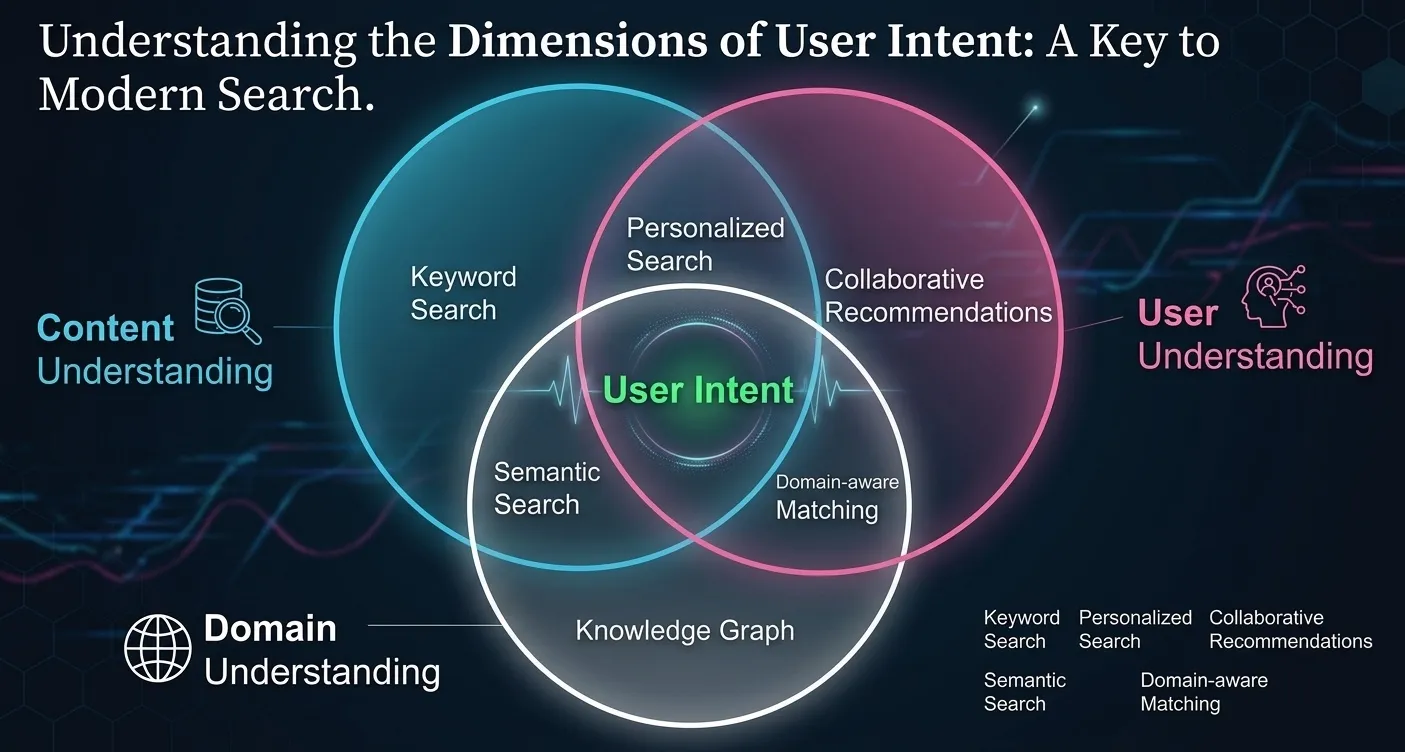
Summary. How content, user, and domain understanding combine to power intent-aware search on a modern acceleration layer.
If you have watched session replays lately, you already know this: people do not type tidy keywords. They paste order IDs with typos, they search for outcomes ("something for plantar fasciitis") instead of SKUs, they bounce between tabs and come back mid-phrase. The search box is doing triage in real time, and every suggestion is a small bet about what they are trying to finish.
The diagram above is our shorthand for that triage. User Intent sits in the middle; Content Understanding, User Understanding, and Domain Understanding are the three partial views you can actually engineer against. No single lens is enough (keyword-only systems prove that daily), but when you stack them deliberately, suggestions stop looking like autocomplete and start looking like product sense.
User intent is the underlying goal behind a search query. It is not merely what the user typed; it is what the user is trying to accomplish.
We care about this split because SuggestAPI sits in the suggestion path, not on a static results page where the user can recover from a miss. That is why the same story shows up in how we describe the product and in the slower walkthrough on the understanding page: typing is cheap; wrong guidance while you type is expensive.
Why Keyword Search Alone Is No Longer Enough
Keywords are still the fastest way to anchor a query to your index. When someone types "running shoes" and means exactly that phrase, you want deterministic matching: no drama, no model drift, just inventory and filters doing their job. Stripping that layer out would be silly; it is the bedrock of recall.
The trouble is how often that is not the shape of the session: half a product name, a symptom described in lay terms, a comparison query where the user never names your category, a reorder where the memorable token is "the blue bag from last time." Lexical overlap can look successful while the intent is wrong, which is worse than an empty state because it looks helpful. That gap is what the rest of this post unpacks, without pretending keywords are going away.
| Search Behavior | What the User Types | What They May Actually Mean | Why Intent Matters |
|---|---|---|---|
| Incomplete query | "waterproof ja" | "waterproof jacket" | Suggestions should complete the idea before the user finishes typing. |
| Synonym-based query | "sofa" | "couch," "sectional," or "loveseat" | Semantic understanding helps match related concepts. |
| Outcome-based query | "best shoes for marathon" | Durable long-distance running shoes | The system needs to infer use case, not just match terms. |
| Domain-specific query | "zero drop trail" | Trail running shoes with zero-drop geometry | Domain knowledge helps interpret specialist vocabulary. |
| Personalized query | "reorder coffee" | A previously purchased product | User context can reduce friction and improve relevance. |
This is where the three dimensions become essential. Content Understanding helps the system understand what exists. User Understanding helps the system understand who is searching and what context surrounds the query. Domain Understanding helps the system understand the meaning of terms inside a specific industry, catalog, or knowledge environment.
The Three Dimensions of User Intent
1. Content Understanding: Knowing What Is Available
Content understanding is the search system's ability to interpret the items, pages, products, articles, categories, and attributes in its index. This includes obvious fields such as titles and descriptions, but it also extends to structured metadata, tags, synonyms, variants, and relationships between entities.
In this framework, content understanding is associated with Keyword Search and Semantic Search. These two techniques work together. Keyword search identifies exact or partial textual matches, while semantic search looks for conceptual similarity between what the user typed and what the content means.
| Capability | Role in Search | Example |
|---|---|---|
| Keyword matching | Finds exact, partial, or prefix-based matches | "bluetooth speaker" matches products containing those terms. |
| Attribute extraction | Uses structured fields to refine relevance | "red dress under $100" maps to color, category, and price. |
| Synonym handling | Connects equivalent or related language | "sneakers" and "trainers" point to the same product set. |
| Semantic similarity | Matches meaning rather than only words | "comfortable office chair" can surface ergonomic chairs. |
Content understanding ensures the search system is grounded in the actual catalog and inventory. Without it, suggestions can become generic, irrelevant, or disconnected from what the store can actually sell. This is especially visible in high-value use cases like ecommerce discovery, large catalogs, and marketplace search.
2. User Understanding: Knowing Who Is Searching
User understanding adds behavioral and contextual intelligence to the search experience. It considers signals such as previous searches, browsing history, location, preferences, purchase patterns, account type, device context, and session behavior.
This dimension matters because two users can type the same query and need different outcomes. A returning customer searching for "coffee" may want a previously purchased blend. A first-time visitor may need popular categories, buying guides, or bestsellers. The gap between those two experiences is part of why better suggestion quality produces practical business benefits, not just nicer UX.
| User Signal | How It Improves Suggestions | Example Outcome |
|---|---|---|
| Recent behavior | Prioritizes contextually relevant suggestions | A user browsing hiking gear sees "hiking backpack" before "school backpack." |
| Purchase or usage history | Makes repeat actions easier | "reorder filters" surfaces the right replacement product. |
| Wholesale vs retail segment | Aligns suggestions with customer type and pricing | Wholesale buyers see bulk packs and case quantities before single-unit listings. |
| Popularity among similar users | Recommends likely next interests | Users who searched "standing desk" also explored "ergonomic chair." |
3. Domain Understanding: Knowing the World the Query Lives In
Domain understanding is what allows search to become truly useful in specialized environments. Every industry has its own vocabulary, relationships, abbreviations, compatibility rules, product hierarchies, and user expectations. A generic search system may understand the words in a query, but a domain-aware system understands the significance of those words.
In technical or specialist contexts, relevance depends on more than text similarity. It depends on knowing how concepts fit together.
| Domain Element | Why It Matters | Example |
|---|---|---|
| Entity relationships | Connects related products, topics, or concepts | A camera body connects to compatible lenses. |
| Category hierarchy | Helps users move from broad to specific | "Shoes" can narrow into running, trail, walking, or dress shoes. |
| Compatibility rules | Prevents irrelevant or impossible results | A replacement part must match a specific model. |
| Specialized vocabulary | Interprets industry-specific language | "Zero drop" means something specific in running footwear. |
The Five Techniques Behind Intent-Aware Search
Intent-aware search blends several methods rather than picking one and hoping it can solve every query. Keyword matching provides speed and precision. Semantic search expands coverage. Personalization adds context. Collaborative recommendations reveal behavioral patterns. Domain-aware matching keeps everything grounded in the realities of the business, catalog, or knowledge base. For how SuggestAPI fits in front of your stack, see the how it works page.
| Technique | Primary Dimension | What It Does Best | Limitation When Used Alone |
|---|---|---|---|
| Keyword Search | Content Understanding | Fast matching for exact terms, prefixes, and common phrases | Struggles with ambiguity, synonyms, and incomplete intent. |
| Semantic Search | Content and Domain Understanding | Matches concepts and meaning, even when wording differs | Needs good content representation and relevance tuning. |
| Personalized Search | User and Content Understanding | Adapts suggestions to individual context and history | Can overfit if it ignores broader catalog relevance. |
| Collaborative Recommendations | User Understanding | Uses aggregate behavior to suggest likely next interests | May miss niche or new items without enough interaction data. |
| Domain-aware Matching | Domain and User Understanding | Applies industry-specific rules, relationships, and vocabulary | Requires structured domain knowledge and ongoing maintenance. |
What This Means for Search Suggestions
Search suggestions are one of the earliest moments where a site can demonstrate intelligence. Before the user even presses Enter, suggestions can clarify intent, correct mistakes, expose useful categories, and shorten the path to conversion.
For SuggestAPI, the opportunity is to help teams move beyond static autocomplete and toward intent-aware suggestions. That means suggestions should not simply predict the next characters in a phrase. They should help users express what they mean and discover what is available. Teams exploring implementation options can also browse the wider resource library for supporting pages and context.
| Suggestion Type | Example | Intent Supported |
|---|---|---|
| Query completion | "wireless noise cancelling headphones" | Helps users finish an incomplete query. |
| Category suggestion | "Headphones > Noise Cancelling" | Guides users into structured discovery. |
| Entity suggestion | "Sony WH-1000XM series" | Surfaces a specific product, brand, or item. |
| Semantic suggestion | "quiet headphones for travel" | Matches the user's use case, not just exact words. |
| Personalized shortcut | "Reorder espresso beans" | Turns search into an action. |
Building Search Around Intent, Not Just Input
The central lesson is that user intent lives at the intersection of multiple forms of understanding. A search bar becomes more useful when it can answer three questions at once: what content is available, who is searching and in what context, and what the query means in this domain.
When these dimensions overlap, search becomes less mechanical and more helpful. It can infer intent from partial signals, guide users toward better queries, connect vague language to specific results, and make discovery feel natural.
Conclusion: The Future of Search Is Intent-Aware
Modern users expect search to be fast, forgiving, and relevant. They expect systems to understand typos, synonyms, preferences, and context. They expect a search bar to behave less like a database field and more like an intelligent guide.
That expectation is exactly why user intent belongs at the center of modern search strategy. SuggestAPI is built around that shift: helping teams create search suggestions that understand more than text.